

Rapid Interest Rate Spikes Won’t Derail the Stock Market
by Alec Young All, Macro Insights, StocksPositive narratives around elevated interest rates are rare.
The bear case centers on both how much yields are up and how fast they’ve risen.
Before you succumb to the game over equity storyline, consider the facts.
History reveals that rapid interest rate spikes won’t derail the stock market.
Today, we’ll show you why avoiding stocks is a mistake right now.
Two time-tested studies prove that equities can handle a swift move higher in 10-year Treasury yields.
These factors are driving a healthy broadening under the surface.
There’s a new winning sector playbook for today’s rate environment.
Institutional money flows reveal the discrete stocks to play this mammoth rotation.
Rapid Interest Rate Spikes Won’t Derail the Stock Market
Speed matters.
The 10-year Treasury yield jumped 140 basis points from 3.9% in March to a mid-October peak of 5.36%.
It’s since backed off to around 5% but remains over 1% higher than March.
Blame stronger than expected growth, record AI-driven corporate bond issuance and sticky oil prices.
This high-velocity spike isn’t a panic-driven surge. It’s a normalization back near the average yield of 5.5% since 1960.
Here’s what the crowd misses.
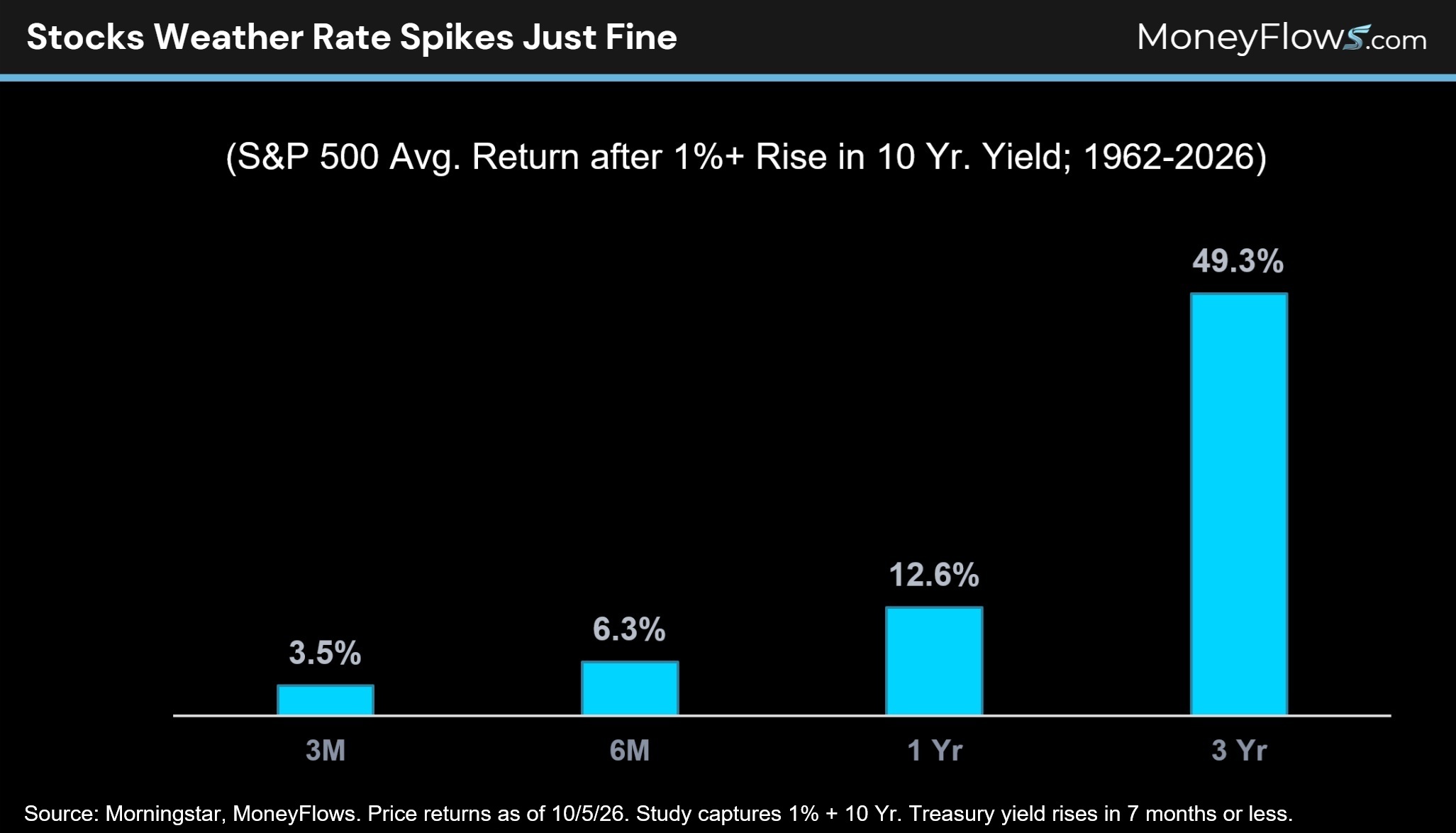
Looking back at every quick 1%+ jump in the 10-year yield since 1962, the S&P 500 has moved higher afterwards, most of the time.
A year later stocks were higher 83% of the time with an average return of 12.6%.
Even better, three years later stocks gained 92% of time with an average total return of 49%:
OK so stocks can handle quick interest rate spikes.
Let’s shift gears and analyze how equities have performed with 10-year interest rates at 5%.
The Real Risk Isn’t High Rates, It’s Recession
Historically, higher-rate environments have been associated with weaker equity returns and lower odds of a market advance.
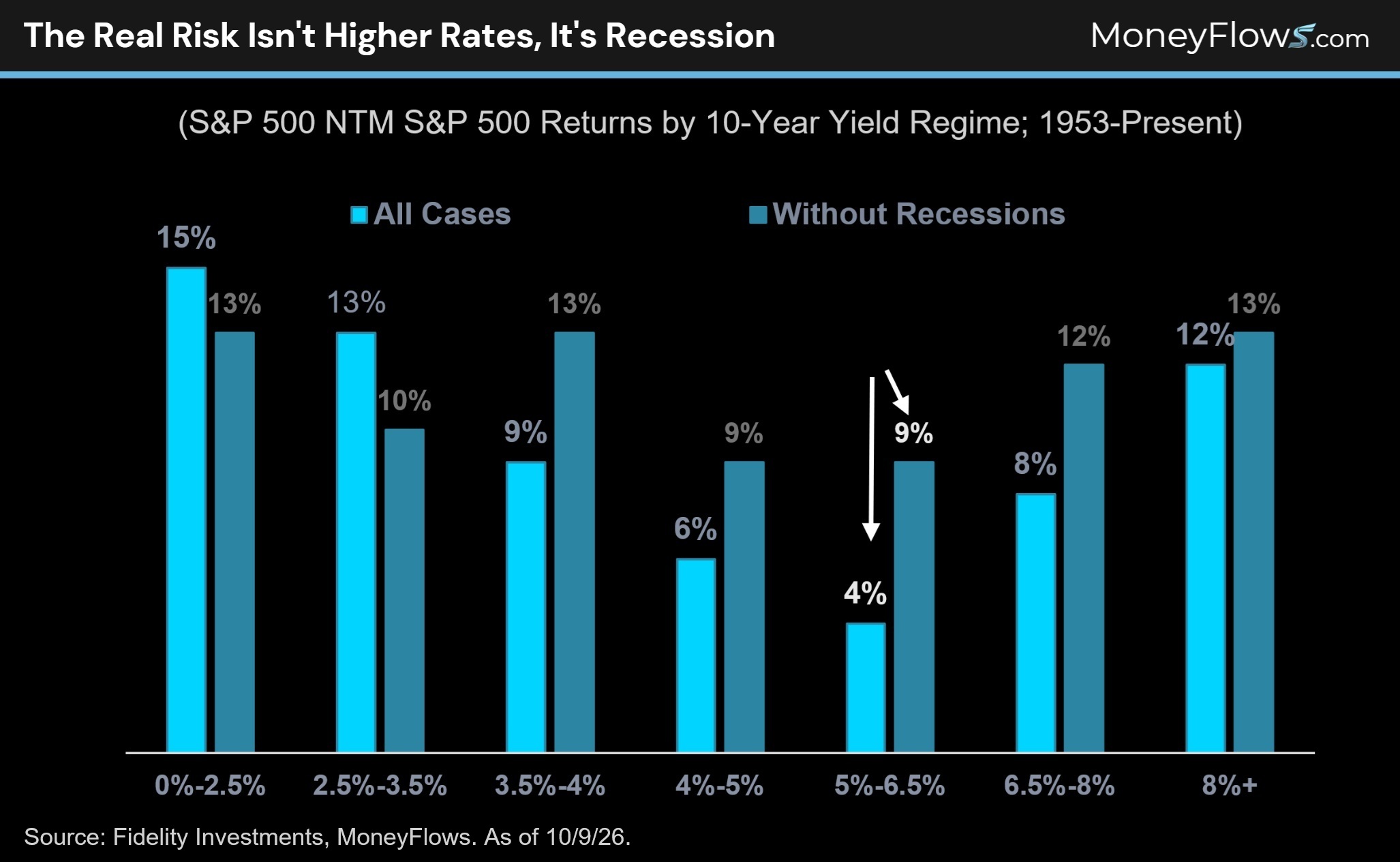
But here’s what the bears miss: Outside of recessions, equity returns are remarkably similar across a variety of interest rate regimes.
While the S&P 500 has returned only 4% per year with 10-year yields between 5% and 6.5% since 1953, that performance jumps to 9% outside of recessions (chart).
Here’s the bottom line - much of the historical stock market penalty associated with higher yields is concentrated in recessionary environments rather than higher-rate environments more broadly.
The latest Atlanta Fed GDP nowcast is 3.2% for Q4. Recession isn’t a realistic near-term worry.
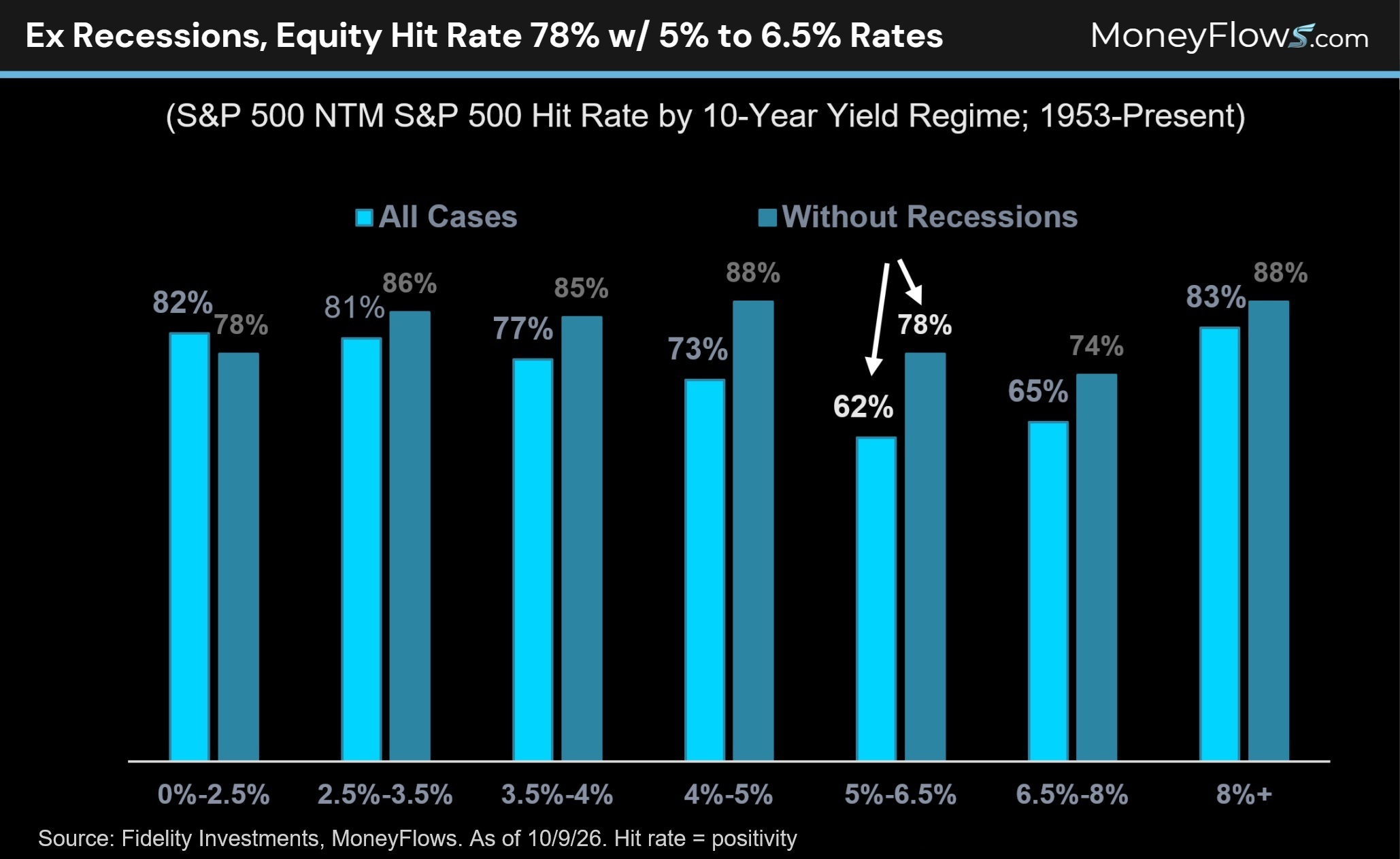
Even better, the odds of positive stock market returns show a similar pattern.
While the S&P 500’s positive annual hit rate is only 62% with 10-year yields between 5% and 6.5%, that jumps up to 78% when dodging recessions.
That’s broadly in-line with the long-term average hit rate of 82% seen outside of recessions:
Higher rates don’t call for dumping stocks, but you do need to tweak what you own.
What This Means for Your Portfolio
Here’s your sector playbook for a higher and more volatile interest rate environment.
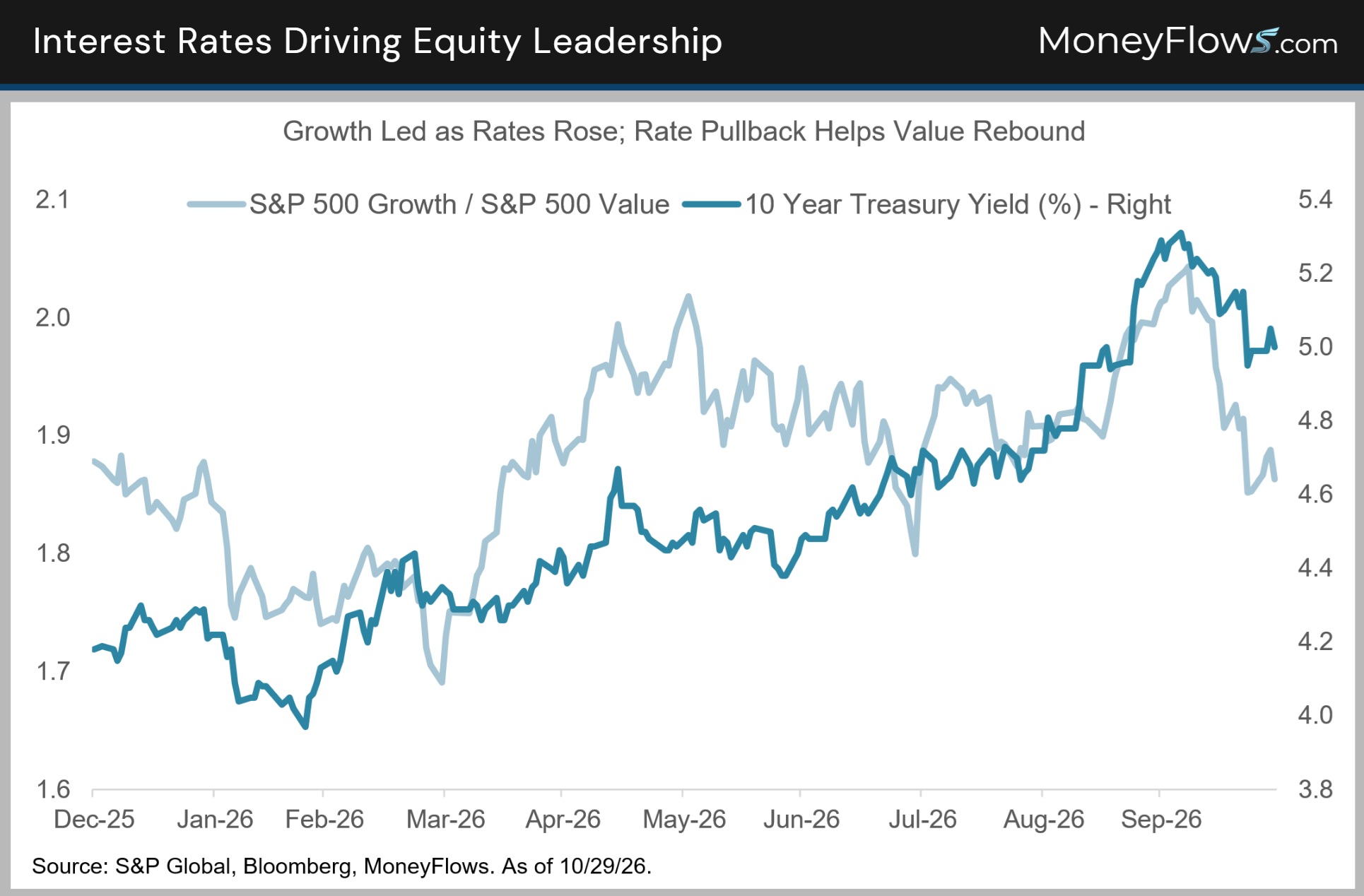
Yields are playing a big role in rotating equity leadership - the cost of money matters for stocks.
Growth stocks have weathered rising rates better than value stocks.
The Mag 7’s 60% weighting in the S&P 500 Growth Index largely explains why growth has led value during the meat of the recent yield spike from June through mid-October (chart).
Their high interest coverage ratios leave them much less exposed to interest rate risk than other stocks.
Value is more heavily exposed to interest rate sensitive sectors like utilities, staples, discretionary, financials, real estate and pharmaceuticals. Small caps fit into this category as well.
All of these sectors are either economically sensitive and hurt by higher borrowing costs, or they pay 3%+ dividends, which become less attractive when interest rates move up.
The recent pullback in rates has helped these lagging sectors finally catch a bid.
Let’s face it – short-term rate moves are hard to call. With everything from AI spending to deficits, geopolitics, energy prices, inflation and economic growth impacting yields, trying to precisely predict their path is a low percentage game.
Suffice it to say choppy, higher for longer interest rates aren’t going away anytime soon.
Here’s the bottom line: 5% yields and higher bond market volatility require a more balanced sector allocation.
You still want to own energy – it’s the perfect portfolio hedge for unpredictable geopolitical risk. But it’s extended and vulnerable if oil falls, so it’s not featured heavily in today’s stock list. Own it as an oil hedge.
Big tech and high-quality industrial AI infrastructure outliers remain buys after 30% declines.
You need to cast a wider net that also includes higher yielding, best of breed health care, discretionary, financials, materials and utilities, staples, real estate and small cap names too.
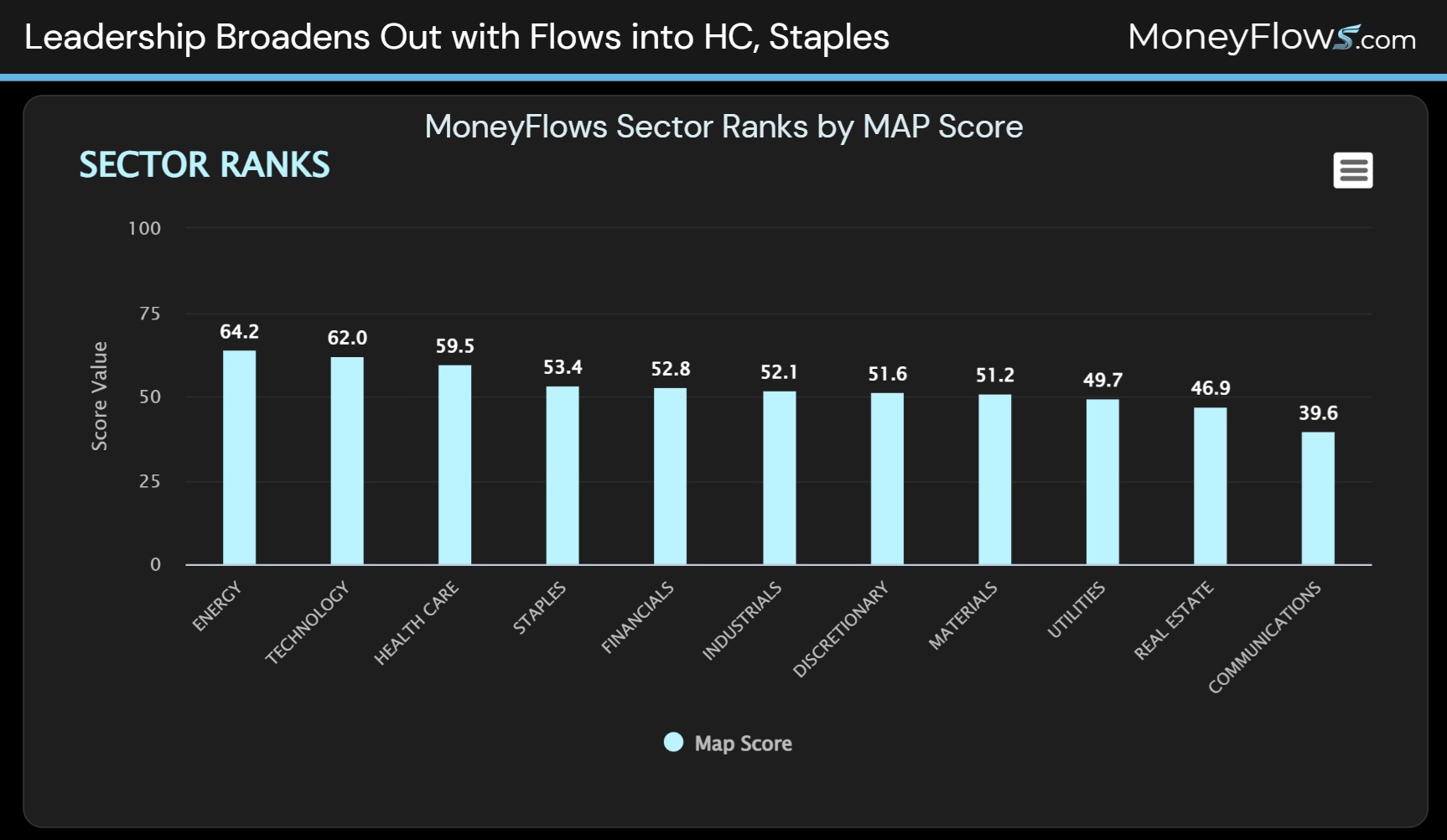
Our sector rankings are sending the same message.
Inflows are broadening out with health care and staples now seeing healthy big money interest alongside long-time winners, energy and tech:
To win big, you need to drill down to individual names.
Not to worry, MoneyFlows was built to find winners.
Today’s stock list reflects the balanced sector allocation needed to win in this market. It’s primarily long growthy tech and health care outliers.
Under-the-surface of the market is a world of hidden opportunity.
To get access and make even more from this call to action, sign up for a PRO (Annual) membership.
You’ll get our proprietary indicators and learn how our unique money flow approach finds outlier stocks early. Give it a shot!
If you’re a money manager or RIA and want portfolio solutions and deep ETF insights, reach out about our Advisor solution here.
Be early next time.
Go with the flows!
Tech and health care are seeing the big inflows in nervous market.
They feature prominently in our latest Outlier 20 most powerful winning stocks with big money activity.