

Behind the Tech Selloff: Why 51% of Stocks Are Secretly in a Bear Market
by Jason Bodner All, Big Money Insights Weekly, StocksTrees don’t lose their leaves in the fall. They cut them off.
Before a leaf drops, the tree pulls back about half of its nitrogen and stores it for spring.
Then it grows a thin layer of cells at the base of the stem and seals the leaf away. What looks like dying is really a tree repositioning for the next season.
That’s how I’m reading this week in the market.
Behind the Tech Selloff
It was a tech wreck – ugly and swift. On Thursday the Nasdaq composite fell 2.6%, Meta dropped 7%, and Nvidia slid 4%. Goldman Sachs said hedge funds sold tech at the fastest pace in at least a decade, mostly by dumping shares they already owned. That same day, all three hedge fund strategies Goldman tracks lost more than 1%. That hadn’t happened since COVID.
This smells like deleveraging. FINRA margin debt hit $1.48 trillion in September, up 31% from a year ago. October numbers won’t come out until next month, but our exchange-traded fund data shows the fingerprints. We saw outflows from leveraged bull funds on the Nasdaq, semis and tech, and an inflow into a 3x bear semiconductor fund. Gold and silver saw outflows too, a classic sign of selling winners to cover losses.
Meta (META) and Tesla (TSLA) were the trigger. Tesla trimmed its 2026 spending plans, and Meta created a new class of non-voting shares. Headlines called it a way to fund AI. But Meta’s own filing ties it to Mark Zuckerberg keeping control of the company and preparing for California’s proposed billionaire tax, which goes to voters on Nov. 3. In the deal, he agreed to stay in California for eight years.
I think the headlines were the excuse, and the real goal was flushing out leverage. Look at what didn’t change.
Meta raised the low end of its 2026 spending range (now $135 billion to $145 billion). Taiwan Semi (TSMC) says its spending through 2028 will be significantly higher than the last three years. South Korean chip exports rose 222% in the first 20 days of October. Order backlogs didn’t vanish, and data centers are still being built.
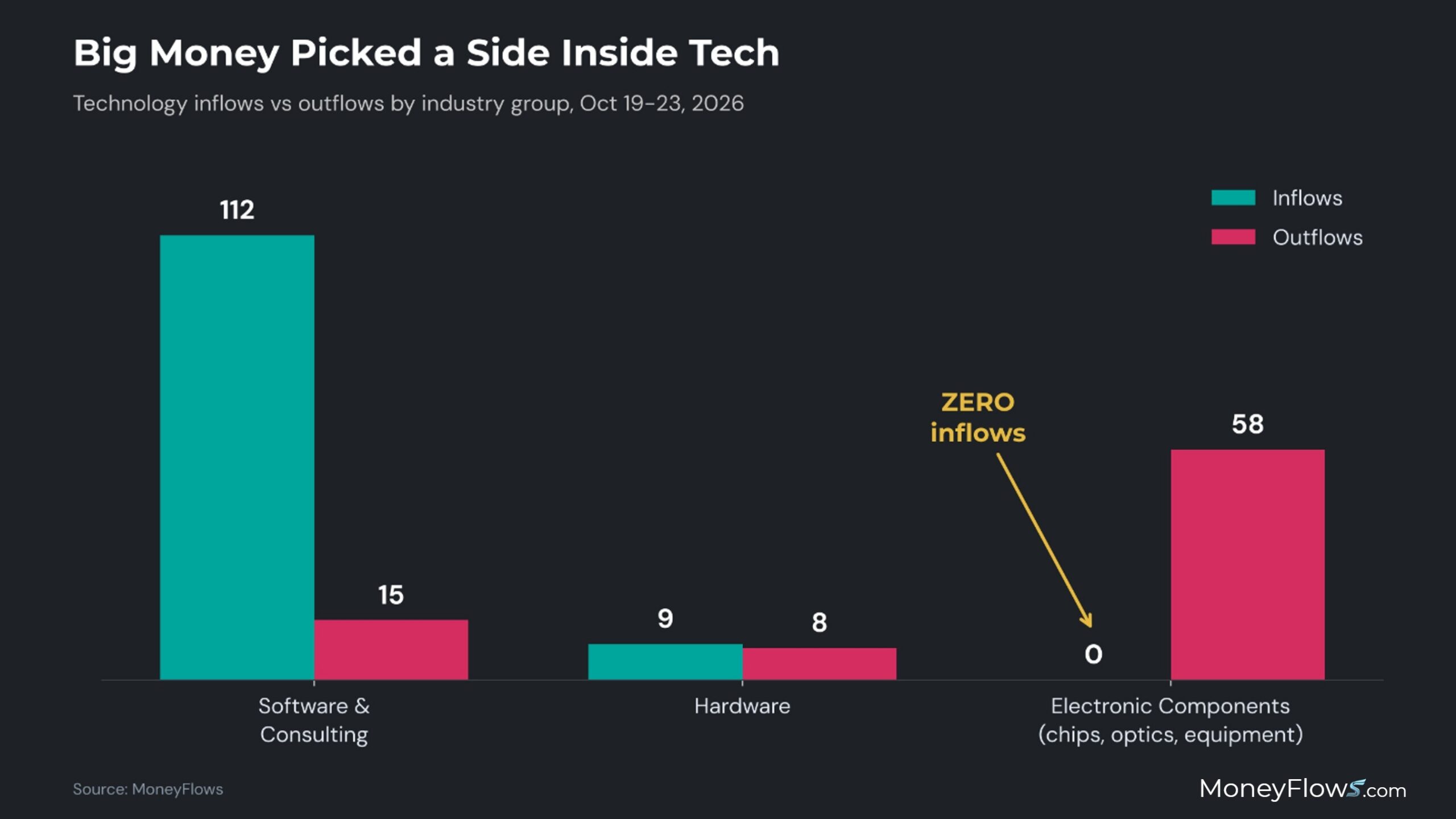
The flows confirm it. Inside tech this week, software and consulting stocks got 112 inflows and just 15 outflows. Electronic components – including chips, optics and equipment – got zero inflows and 58 outflows. Not one inflow.
That’s ironic. Earlier this year everyone said AI would kill software, the so-called “SaaSpocalypse.” Now software is the best group in tech. The median software stock is up 4.2% over the past month. Semiconductor equipment stocks are up 44.7% this year but down 20.6% in a month, and 94% of them are now in bear markets. This year’s winners are being sold to pay the bills.
Why 51% of Stocks Are Secretly in a Bear Market
The rotation goes beyond tech. Health care led all sectors with 60 more inflows than outflows this week. Staples and utilities drew inflows too. Industrials were the worst, at 74 more outflows than inflows, and much of that hit the AI power and buildout names. On Friday, energy flipped hard, with 20 inflows and 2 outflows as Brent crude settled at $116.72, a six-month high.
Bonds told the same story. On Thursday, the 10-year Treasury yield had one of its biggest one-day drops in about two years and fell below 5%. Early in the week, traders were still pricing a small chance the Federal Reserve would hike rates. By Friday, those odds had fallen to about 5%.
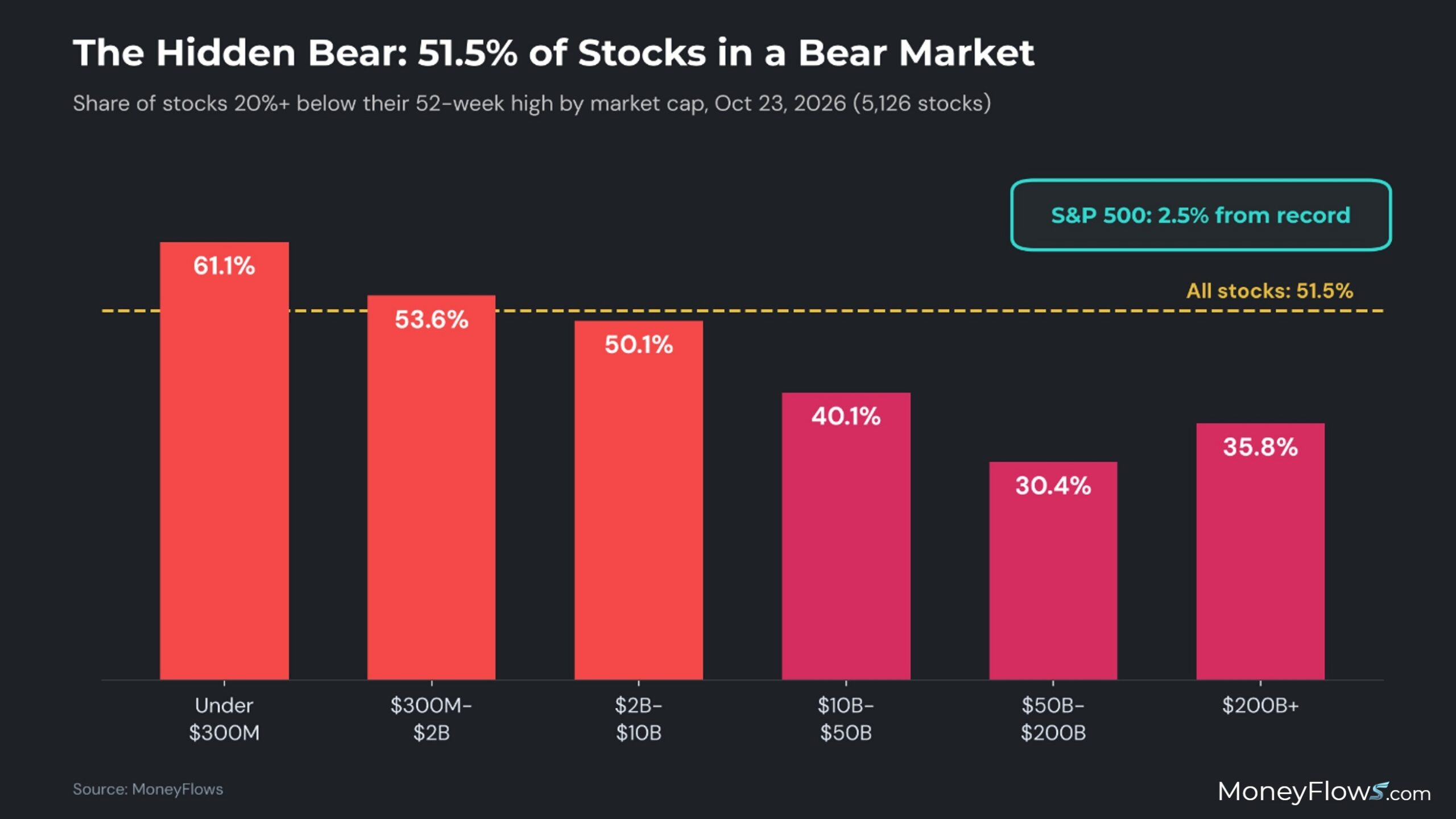
Under the surface, things are worse than the indexes show. The S&P 500 is only 2.5% below its Oct. 6 record. But of the more than 5,100 stocks we track, 51.5% are in bear markets, meaning they’re down 20% or more from their highs. It gets worse as stocks get smaller, reaching 61% for companies under $300 million.
So, did Thursday wash things out? Not exactly, and that’s the encouraging part. Big Money logged 186 outflows that day on heavy volume. But there were also 152 inflows, the most since Aug. 4. That’s not one-way panic. It was Big Money repositioning by selling AI hardware to buy software, health care, and staples.
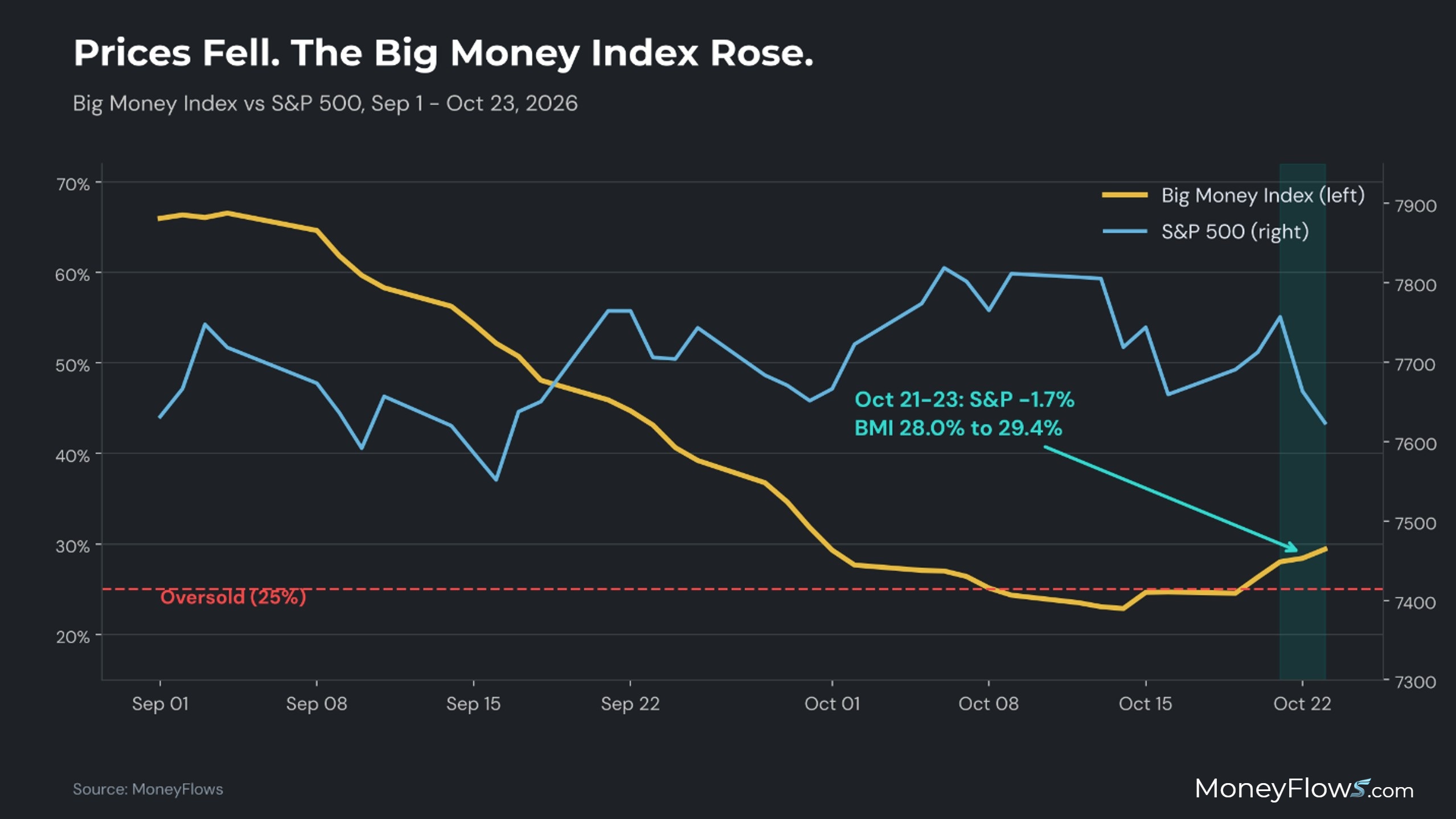
And the Big Money Index kept rising right through the selloff, from 28.0% to 29.4%. It climbed out of oversold territory on Oct. 20. Since 2010, the S&P 500 has been higher one year after every BMI exit from oversold. That’s 12 for 12.
We’ve seen this movie in past midterm years.
In 2014, the S&P 500 fell 7.4% into an Oct. 15 low, then hit a new high 12 trading days later. In 2018, small-caps fell 12.3% from Aug. 31 to late October while the S&P 500 dropped just 5.5% – a huge rotation. In 2022, the Nasdaq 100 was down 32% for the year at its October low, then gained 36% over the next year.
This year is following the 2022 script, with a twist. This time, the tech bear is aimed only at AI hardware, while the main indexes hold up. And in each of the last three midterm years, the BMI went oversold in the fall, just as it did this month.
I looked at every midterm year since 1990, starting from Oct. 23. The S&P 500 was higher one year later all nine times, with an average gain of 14.3%. The Nasdaq 100 was higher all nine times too, averaging 36.2%.
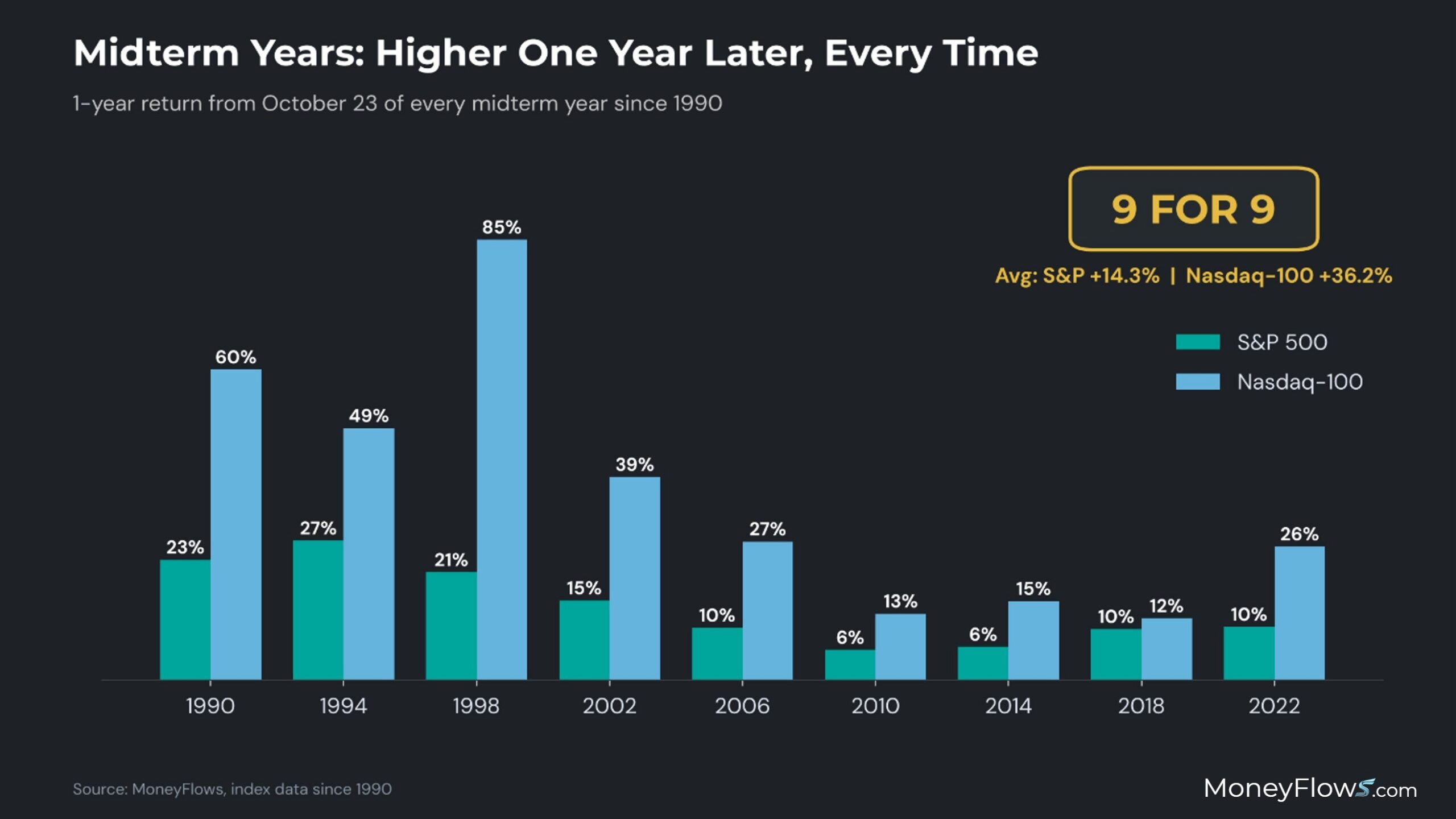
To be fair, the road to year-end isn’t always smooth. The S&P 500 was higher by Dec. 31 in only six of those nine years, and 2018 got much uglier before it got better.
Prediction markets on Kalshi and Polymarket give Democrats about a 91% chance of taking the House and 67% for the Senate. That points to gridlock, which markets have handled just fine before. The uncertainty should clear soon after Nov. 3.
AI hardware is shedding leverage like a tree drops its leaves, but leaves come back. Big Money is moving back into software, health, and energy, getting ready for next season.
Marcus Aurelius wrote, “Loss is nothing else but change, and change is Nature’s delight.”
This week felt like loss. The data says it was change.
MoneyFlows finds the winners early…bringing them to you.
If you’re a serious investor or money manager, get started NOW.
Our PRO subscription allows you to spot daily flows and access our weekly Outlier 20 report.
This is the report that has found EVERY SINGLE ONE of our Outlier stocks.
Enjoy a click-through experience unlike anything out there.
Professional money managers and RIAs looking for additional portfolio solutions including ETF flows & ranks and your own Portfolio Tracking tools, please reach out about our Advisor Solution and Emerging Advisor Program.
Have a great week!
***Lastly, join me LIVE, Nov. 30 – Dec. 2, at the MoneyShow Masters Symposium Sarasota, FL. I’ll be presenting: Why the Midterm Election Historically Brings Epic Rallies – And What to Buy Now.
You don’t want to miss this! Click the image below to reserve your spot.