Are Tariffs and High Economic Uncertainty a Reason to Sell Stocks?
by Alec Young All, Macro Insights, StocksEconomic uncertainty has rarely been higher.
Worries range from tariffs, a rekindling of inflation, an end to Fed easing, rising rates, and high valuations.
It’s a scary list.
Today we’ll unpack an evidence-rich dataset to keep you invested. And we’ll help you answer the burning question on everyone’s mind:
Are tariffs and high economic uncertainty a reason to sell stocks?
Here’s the good news. Don’t sweat all the noise. Bull markets always climb a wall of worry. It’s not unusual. In fact, it’s a good thing.
Here’s why:
When no one’s worrying, it means the crowd is already all-in on stocks and the rally will stall as demand dries up.
Worries are an essential feature of every bull market. They’re a reason to buy, not sell.
Let’s dive deeper into why high economic uncertainty is buyable...not the other way around. Then, we’ll totally debunk the bears’ latest big worry - tariffs.
Finally, we’ll wrap up with the single best sector to be overweight right now.
Are Tariffs and High Economic Uncertainty a Reason to Sell Stocks?
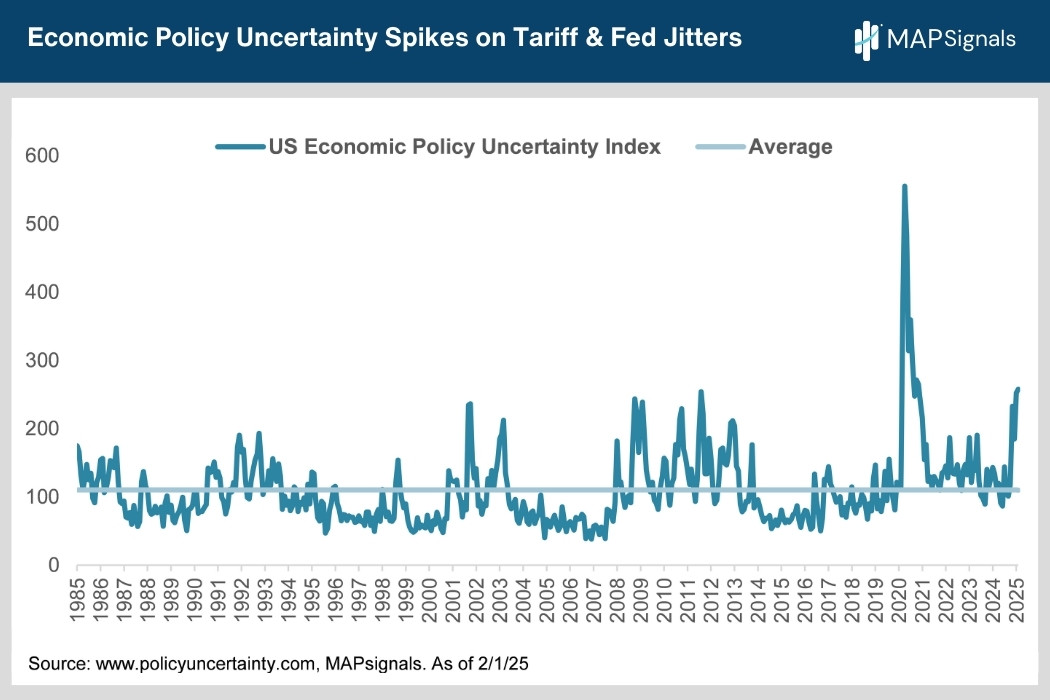
The US Economic Policy Uncertainty Index seeks to measure macro headline risk based on news coverage, reports from the Congressional Budget Office, and a survey of economic forecasters.
Today’s business landscape is wildly in flux – monetary policy, fiscal policy, trade, and regulation are all up in the air.
Against this backdrop, it’s no wonder policy uncertainty is at its highest level since it peaked in 2020 at the height of the Covid pandemic (chart).
We analyzed how equities perform after periods of high policy uncertainty.
It turns out, extreme policy uncertainty is actually bullish for stocks.
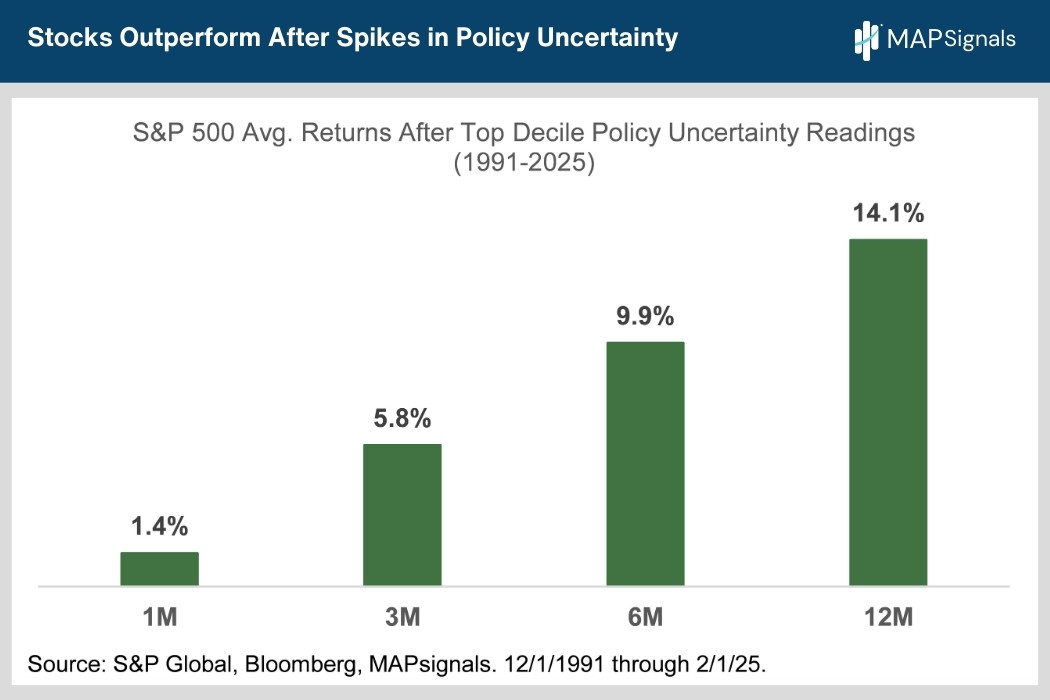
Since 1991, the S&P 500 has averaged outsized gains of 1.4%, 5.8%, 10% and 14% over one, three, six and 12-months, respectively, after top decile readings in the economic policy uncertainty index.
Don’t fall for the bear bait.
High economic uncertainty is a buy signal:
OK, let’s move on. History isn’t the only reason to fade high uncertainty.
Tariffs are the #1 reason uncertainty is so high.
We first addressed tariffs on December 9, in our 2025 Outlook: Look Outside S&P 500 to Unlock Big Gains.
Back then we told you “Trump’s tariff bluster is likely just a negotiating ploy on the way to economic policies that are milder than feared.” It’ still early days but so far so good.
Remember, markets don’t need risk-free conditions. When stocks are pricing in something really nasty, outcomes that are merely better than feared are all equities need to keep rallying.
That’s exactly what’s happening - it’s why the S&P is near all-time highs despite endless tariff bluster.
Here’s another huge reason investors aren’t buying the trade war hype:
Exports and imports combined represent only 25% of US GDP vs. 84% for the EU, Mexico at 73%, Canada at 67% and 34% for China (chart).
In simple terms, the U.S. has the advantage at the tariff table:
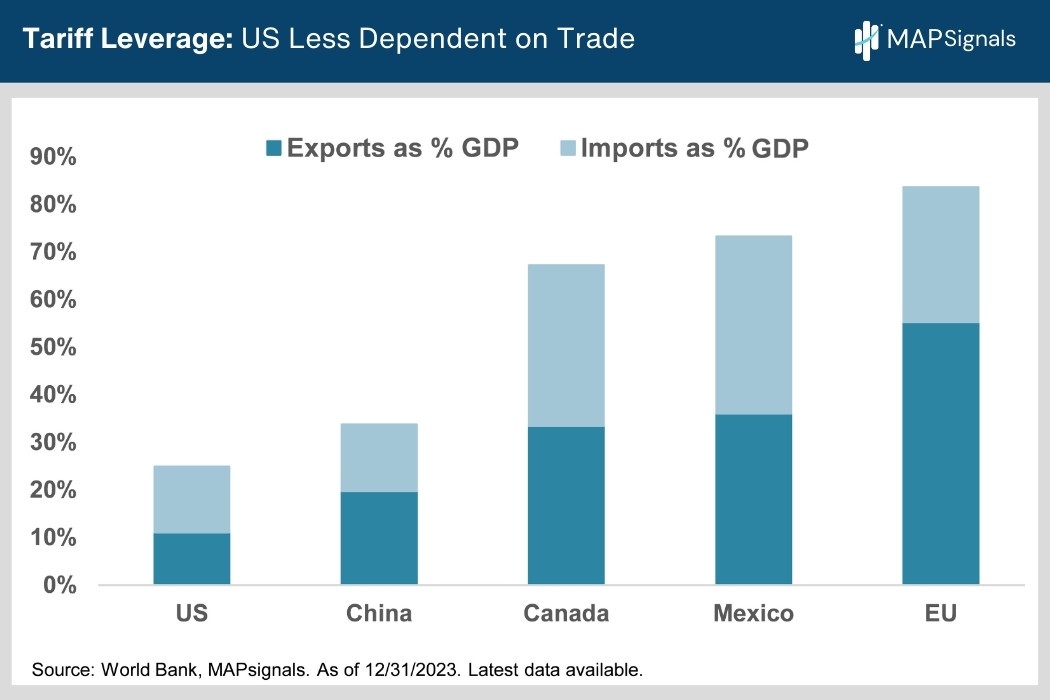
Consequently, the newly announced tariffs and any retaliatory measures will have less of an economic impact on America, strengthening U.S. leverage in trade negotiations.
The bottom line is tariffs will hurt America’s major trading partners far more than they hurt the US.
Europe, Mexico, Canada and China have a huge incentive to cut a deal.
There’s an investment opportunity here, folks.
How to Tilt Your Portfolio
We’ve made the case for buying stocks despite high macro uncertainty. Now, let’s tackle portfolio construction.
Regular readers know we favor cyclical sectors. Financials have been a top pick for over a year. The sector is up 7% YTD vs. only 4% for the S&P 500 (chart).
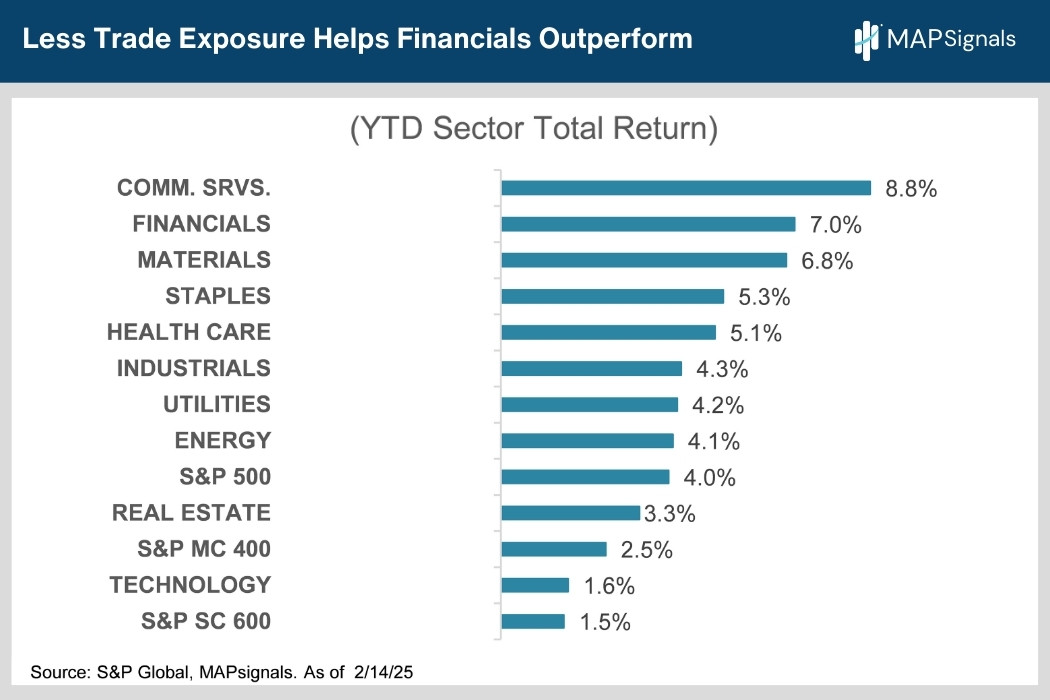
Many of the sector’s long-standing tailwinds remain in place – accommodative financial conditions, above average exposure to deregulation, accelerating M&A and IPO activity, as well as attractive relative valuations and dividend yields.
But as tariffs have moved up the market’s worry list, the financial sector’s more domestic focus is also helping it outperform.
According to FactSet, only a quarter of S&P 500 financial companies mentioned tariffs on recent Q4 conference calls vs. the S&P 500’s 50% rate. That’s probably because financials derive only 22% of their sales overseas, vs. 40% for the broader S&P 500.
Here’s another big reason to like financials. Since 1991, the S&P 500 financials sector has averaged outsized gains of 4.6%, 8.3% and 22.8% over three, six and 12-months, respectively, after top decile readings in the economic policy uncertainty index.
Good luck, bears!
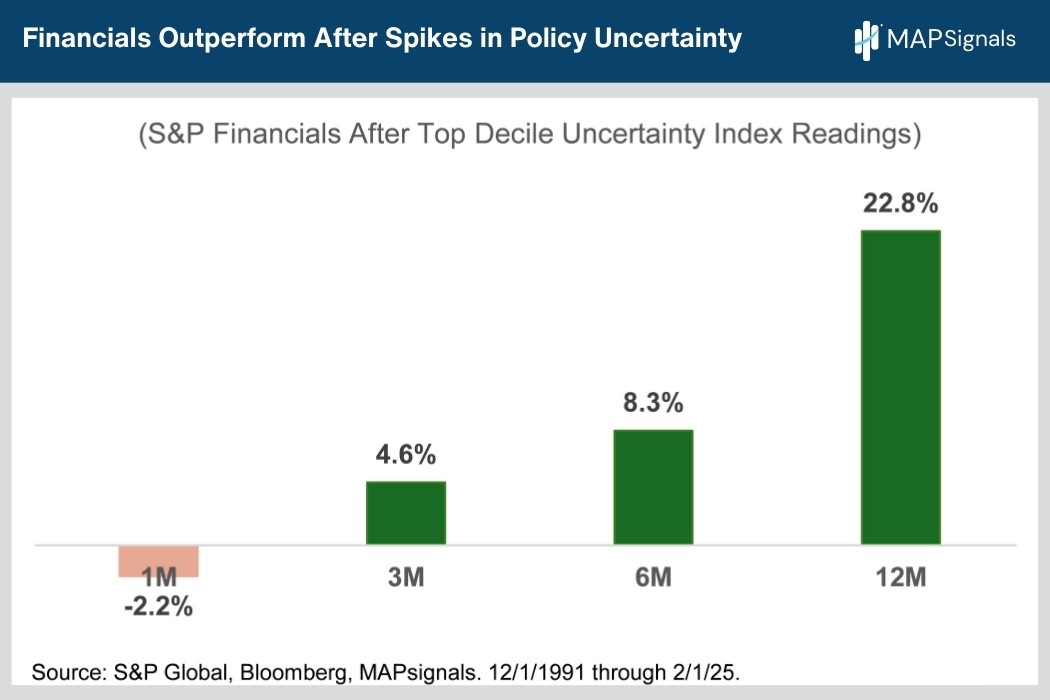
Given financials’ strong macro tailwinds, it’s no surprise the sector is seeing heavy institutional buying.
Let’s go over the latest sector rankings for Pro members and the best stocks to play this theme.