

Mag 7 Weakness Accelerates Rotation into Dividend Stocks
Healthy rotation and market broadening are hallmarks of great bull markets - it’s how they last so long.
The current bull market is the 8th longest in history, up 107% since October 12, 2022.
That said, markets are shifting out of popular core names and into prior benchwarmers.
Mag 7 weakness accelerates rotation into dividend stocks.
And it’s not just income stocks that are part of this catch-up trade.
Left-behind small-caps are a case in point. On May 18, we told you how Small Cap Stocks Are Cheap and Growing Faster Than Mega-caps.
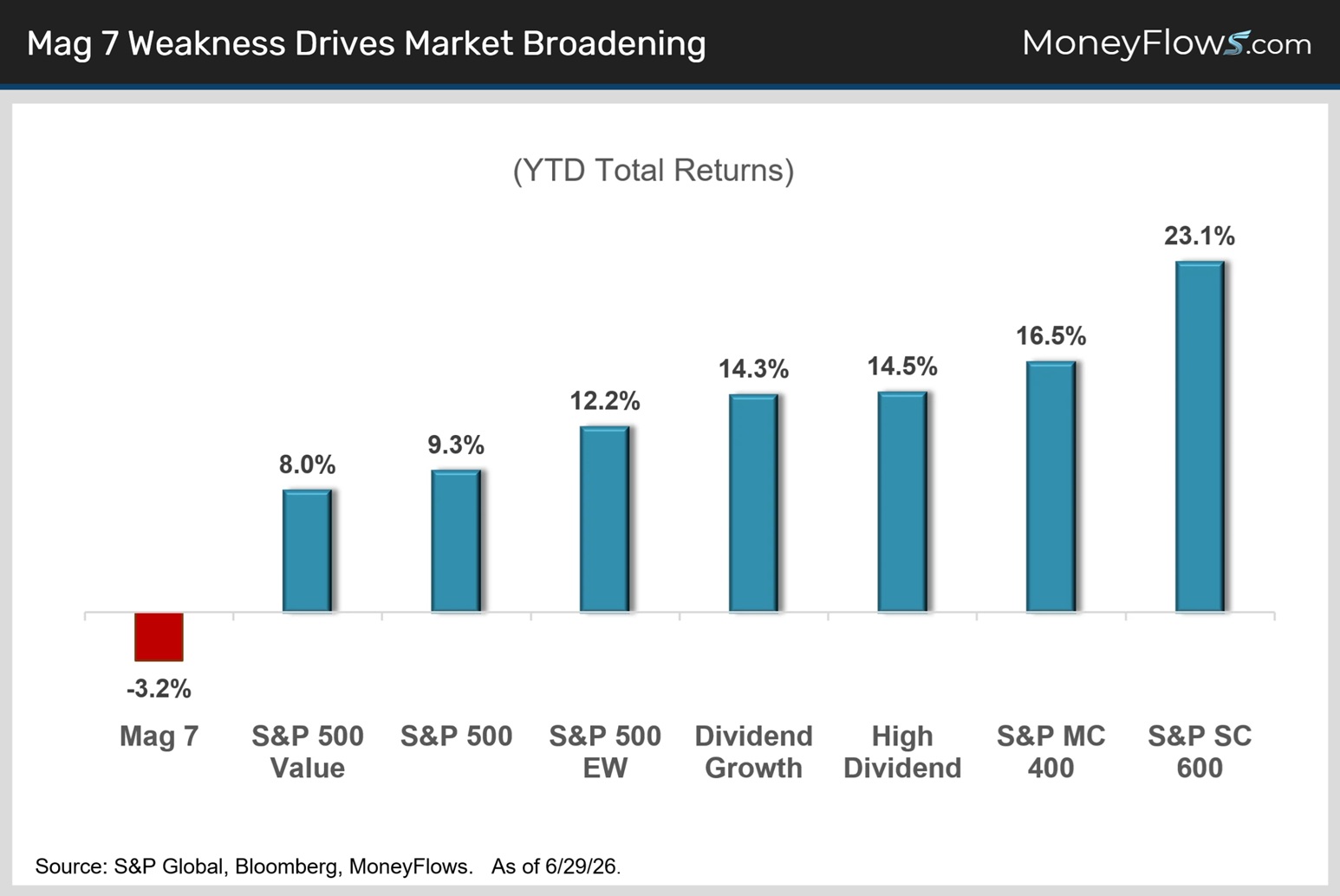
Small-caps are now up 23% YTD, more than double the S&P 500.
If you missed that setup, don’t worry.
Today, we’re zeroing in on another juicy opportunity in dividend stocks.
First, we’ll explain the mechanical forces accelerating the rotation into dividend payers.
Then, we’ll unpack three evidence-rich studies proving dividend payers’ “all weather” attributes make them must-own portfolio diversifiers as the tech trade narrows, making the stock market choppier.
Lastly, we’ll show you why dividend stocks are a great alternative for a slice of your bond allocation.
And we’ll offer 25 juicy dividend compounders that are benefiting from this mammoth rotation.
Mag 7 Weakness Accelerates Rotation into Dividend Stocks
Market mechanics matter more than ever because the stock market has never been so concentrated.
The S&P 500’s 31% weighting in the Mag 7 is huge. When they underperform, huge amounts of liquidity need a home... safer, cheaper stocks fit the bill.
Collapsing software stocks only add fuel to this fire.
Tech selling is accelerating inflows into less expensive, safer dividend payers. Long-time lagging sectors like health care, real estate, staples and discretionary are beneficiaries.
Healthy buying pressure in long-standing winners including financials, utilities, materials and industrials.
At the sub asset-class level, the rotation out of big tech is helping small and mid-caps, the equal weight S&P 500, dividend stocks and value stocks, all of whom have more exposure to the aforementioned catch-up sectors than the S&P 500.
They’re all up nicely YTD, easily outperforming losses in the Mag 7 (chart). That hasn’t happened in years.
We think it persists as tech leadership shifts from a momentum trade to a more discerning, fundamental trade.
We expect tech performance to remain bifurcated as investors reward immediate AI monetization (semis/infrastructure) while punishing heavy AI capex absent a clear ROI (Mag 7), as well as potential AI disruption victims (software).
Narrower tech leadership means the liquidity tailwind favoring dividend stocks is here to stay.
But that’s hardly the only reason to like dividend strategies.
Dividends Shine When Markets Get Choppy
The bull market isn’t over, but we expect a choppier ride as the all-important tech trade gets more selective.
Dividends often act as a shock absorber, padding returns when markets turn choppier.
Here’s why:
Albert Einstein once described compound interest as the “eighth wonder of the world.” He was 100% right.
When you reinvest your dividends, you’re investing a growing amount year after year. S&P 500 dividends have compounded at a 6.3% annual clip since 2000.
It adds up fast. In 2026, S&P constituents are forecasted to pay out a record $618B in dividends, up more than 300% from the $139B paid in 2000.
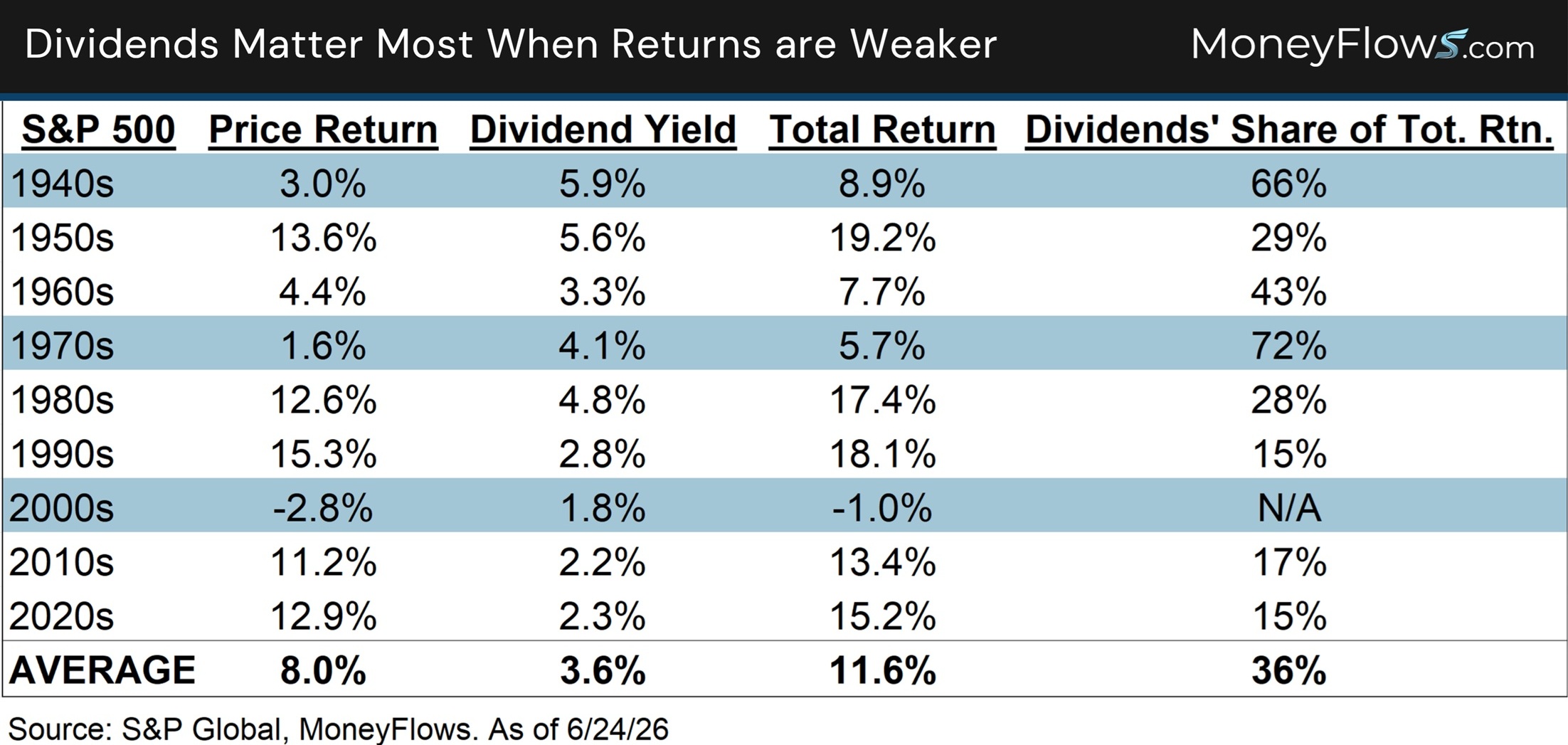
Thanks to the wonder of compounding, dividends account for 36% of long-term S&P 500 total returns (chart). The S&P 500 has returned 8% a year without dividends vs. an 11.6% with reinvested payouts.
Below you can see how dividends have helped returns over time, especially in weaker markets in the 1940s, 1970s and the 2000s.
Read on to learn more about how dividend stocks offer a smoother ride.
Dividend Stocks Offer Less Risk and More Reward
Higher risk adjusted returns are the holy grail of investing.
Dividend stocks don’t just throw off a growing income stream, they also outperform with less risk.
Regularly returning capital reflects a well-established business with a strong market footprint.
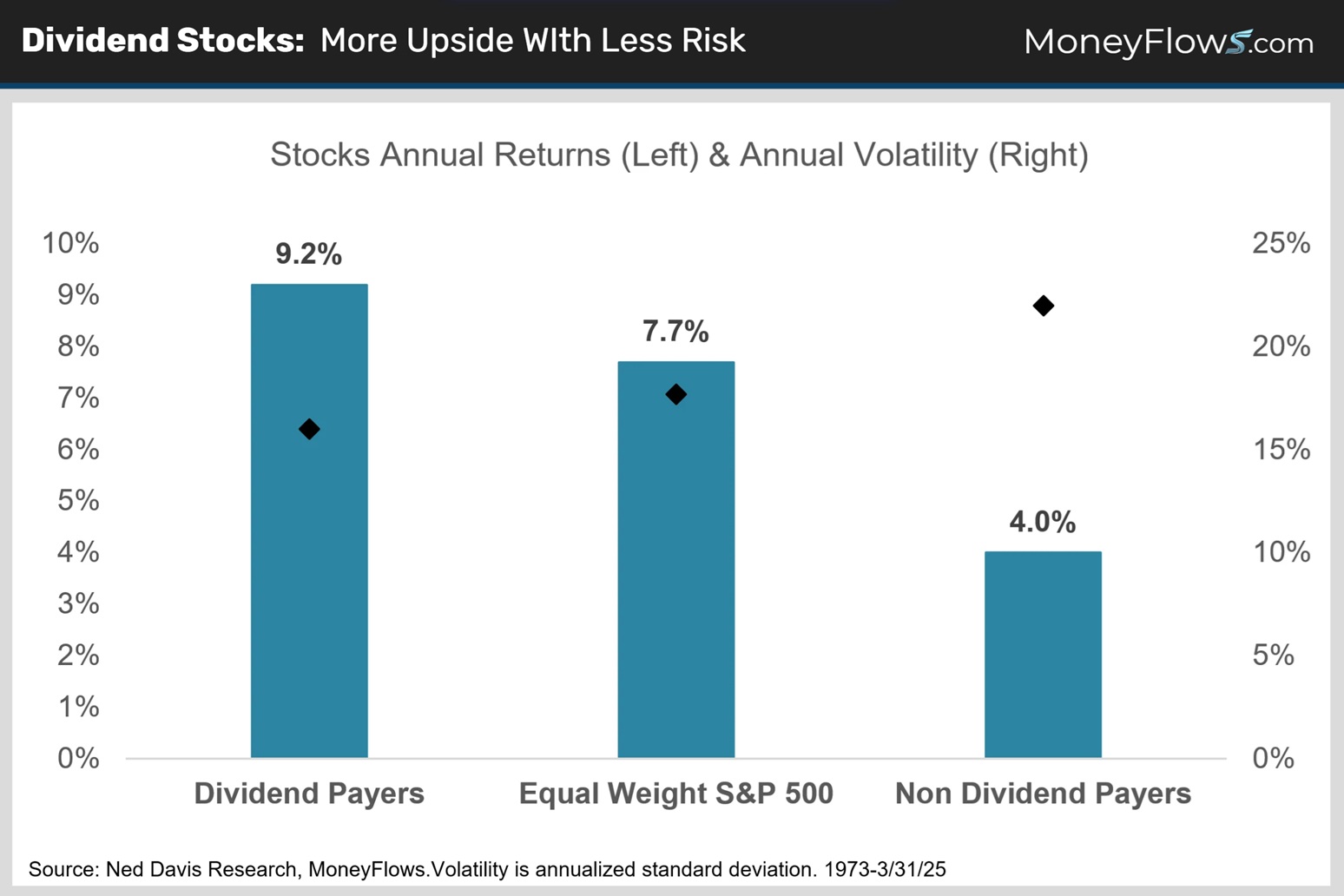
It’s no surprise a recent study by Ned Davis Research shows that, since 1973, dividend-paying companies significantly outperformed non-dividend payers while also being notably less volatile.
S&P 500 dividend payers annualize gains of 9.2% vs just 4% for non-payers:
That’s a powerful 1-2 punch!
Wait. The dividend risk hedging story gets even better.
Dividend Stocks Hedge High Volatility
Typical dividend-payers sport financial strength and disciplined management. That’s especially valuable when markets turn rocky.
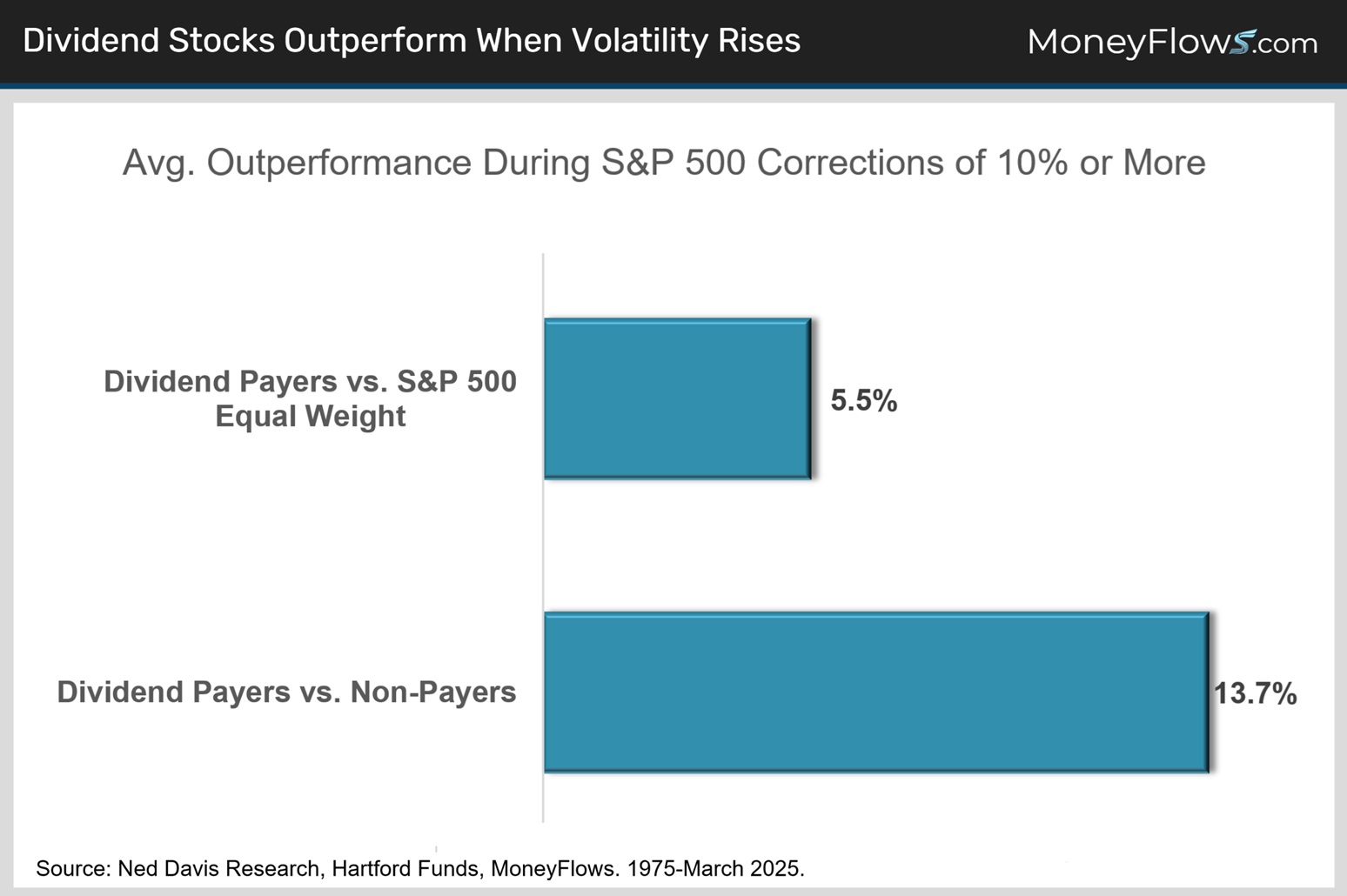
During S&P 500 drawdowns of 10% or more, dividend-paying stocks have held up better than companies that don’t pay dividends.
Since 1975, dividend-paying stocks declined by 14.4% during major market drawdowns.
By contrast, the equal-weighted S&P 500 Index fell by 19.9%, and non-dividend-paying stocks were down even more sharply, collapsing an average of 28.2%.
In other words, while all three cohorts experienced losses, dividend-paying stocks registered smaller declines - outperforming non-dividend payers by 13.7% and the equal-weighted S&P 500 Index by 5.5%:
Let’s shift gears to your actionable portfolio allocation.
Dividend Stocks Hedge Inflation Better than Bonds
High quality dividend stocks are a great alternative for a slice of your bond allocation.
Bonds play a critical risk management role in investment portfolios. Treasuries can zig higher when stocks zag lower - usually when recession fears threaten corporate earnings.
We’re not suggesting eliminating bond exposure. But times have changed and smart investors need to change with them.
After a 40-year bull market that saw long-term rates collapse from over 10% in the 1980s to less than 1% by 2020, rates have been rising for the last five years and show no signs of heading sustainably lower.
Blame record deficits and unprecedented political partisanship.
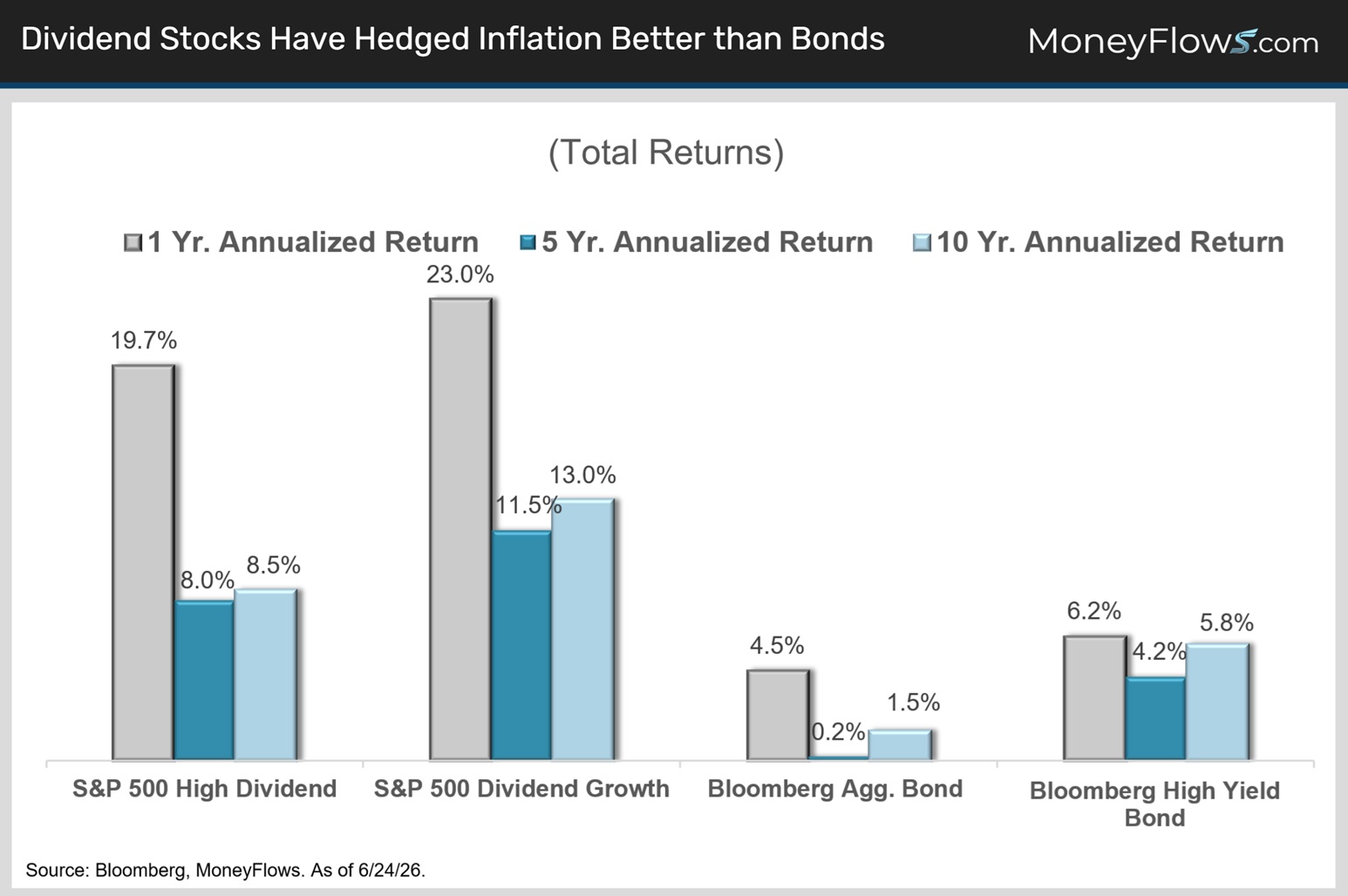
The Bloomberg US Aggregate Bond Index – the leading core US fixed income benchmark – has produced just 4.5%, 0.2% and 1.5% annualized total returns, over the last 3, 5, and 10-years, respectively (chart).
That’s not even enough to consistently beat the 3% average long-term inflation rate.
Meanwhile, high yield bonds have done better with returns in the 5.5% range, but they don’t offer core bonds’ diversification benefits because their credit risk boosts their correlation to stocks.
What’s an investor to do? Diversify!
Dividend strategies focus on either high yields or dividend growth. Most equity income investors own stocks in both categories. Both have strong long-term performance.
Check out how dividend stocks crushed high yield bonds and core bonds since 2016.
The best 1, 5, and 10-year annualized returns are seen in the S&P 500 Dividend Growth basket with 23%, 11.5%, and 13% respectively.
The goal of today’s piece is to highlight a powerful rotation into new emerging winners.
As such, today’s stock list features blue chip payers from a mix of newly resurgent sectors like health care, real estate and parts of discretionary and staples.
We’ve been big fans of long-time winners like tech, industrials, financials, utilities and materials and have recommended them repeatedly over the last three years so they’re intentionally less prominent on this list.
All of the stocks listed have a wide moat – they’re generally the #1 player in their respective industries.
They also all have either a dividend yield above 2.5% or a track record of strong dividend growth, or both, and sustainable payout ratios to enable future income growth.
Lastly, they all have MAP Scores ranging from 50 to 74 indicating growing accumulation without being overbought.
Where most research houses got it wrong in 2026, MoneyFlows got it right.
Good things happen when you follow the data instead of the crowd!
As markets consolidate their huge gains, lean into compounding dividend payers favored by institutions to outperform.
To get access and make even more from this call to action, sign up for a PRO membership.
You’ll get access to our proprietary indicators and learn how our approach finds the best stocks in the market.
If you’re a money manager or RIA and want portfolio solutions, reach out about our Advisor solution here.
Be early next time.
Go with the flows!
Our data is built to find the outlier stocks ahead of the crowd.
Below, for PRO subscribers, is a sector diversified list of 25 elite dividend compounders under increasing accumulation as ranked by our proprietary MAP Score.