
Photonics Special Report
by Jason Bodner All, Special Report, StocksThe computer that helped land humans on the moon during Apollo 11 had about as much power as a basic digital watch.
The modern iPhone is about 1 million times more powerful.
But Apollo still worked because the system around it was tightly coordinated.
The AI Speed Problem
Today, A.I. has a speed problem, but not the kind most people think about.
Let’s unpack the problem, the solution, how once again the silent money knows first, and the huge opportunity ahead of us…
We know that chips are already incredibly powerful. Today’s AI processors are the fastest computing devices ever built. The real limitation is less obvious: the time it takes for data to move.
Inside an AI system, nothing happens by itself. You don’t have one chip quietly processing information on its own.
Thousands of processors work together, constantly exchanging data. Every operation depends on information arriving from somewhere else, which means the system is only as fast as its ability to communicate.
This is where things get interesting. Data doesn’t move like files across a screen. It moves as signals, and increasingly, those signals are not electrical.
They are optical… transmissions of light.
The Mechanics and Limits of Light
A photon is the smallest unit, or quantum, of light. At a basic level, information moves as pulses of light, with billions of photons carrying each signal.
Each pulse represents data, on and off, one and zero. Instead of traveling through copper wires, these signals move as light waves pass through strands of glass thinner than a human hair.
When AI systems communicate, they are flashing messages to each other at the speed of light.
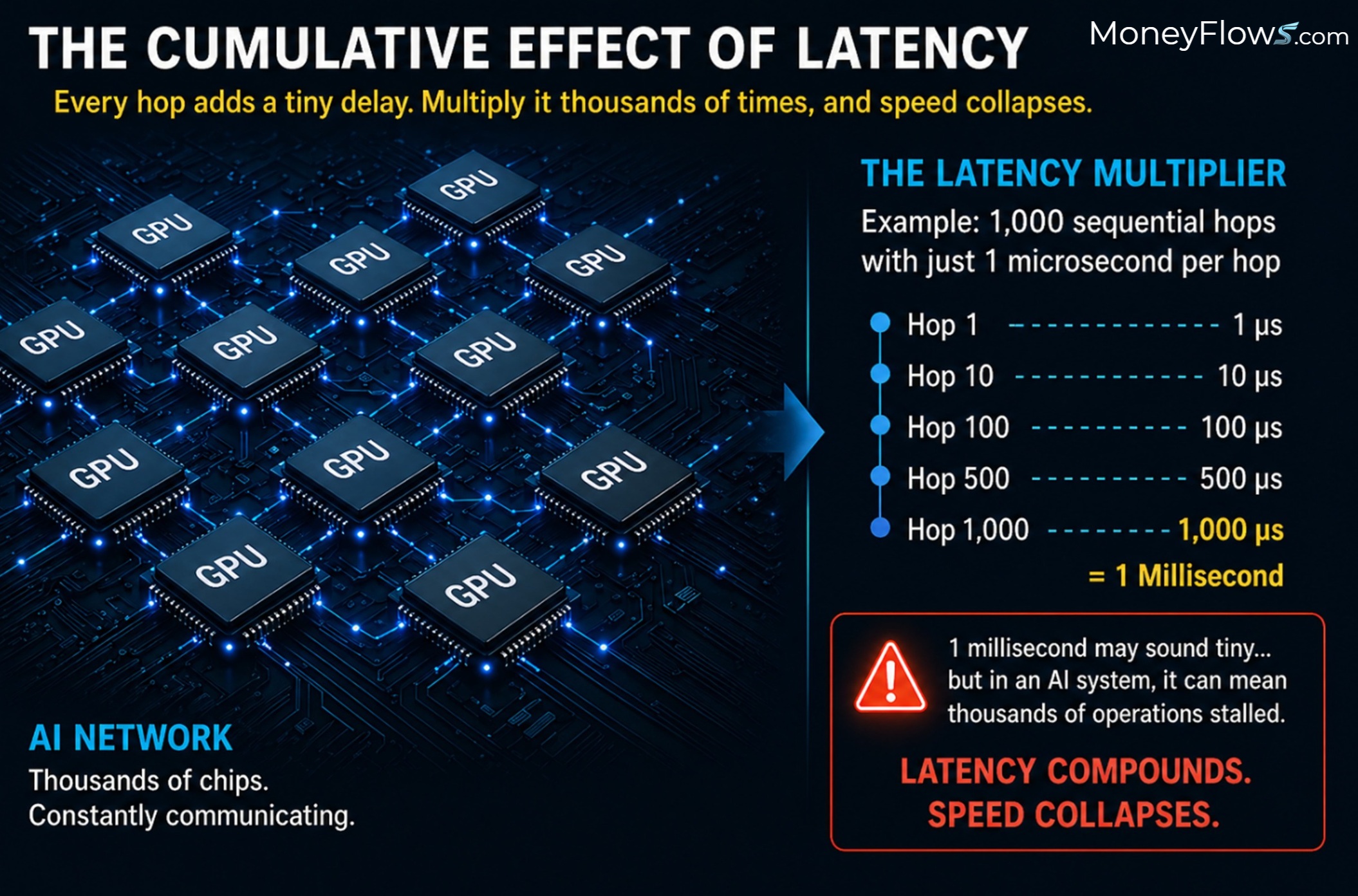
Light travels at roughly 186,000 miles per second in a vacuum. But inside fiber it slows to about two thirds of that pace because the glass introduces resistance. This is due to the refractive index of the material, which for fiber is around 1.44 to 1.5, bringing effective speeds closer to 125,000 miles per second.
A simple way to think about it is that light, like sound moving through a dense forest, constantly interacts with its environment. At microscopic levels, photons are absorbed and re-emitted, so while they move extremely fast, the signal takes longer to propagate.
Fiber is already close to its physical limit, with only modest gains left. The constraint has shifted to everything that slows light along the way.
Latency builds from distance, routing, and repeated optical-to-electrical conversions, while signal loss over long distances requires amplification that adds delay.
Progress now comes from improving efficiency, reducing friction, minimizing conversions, and increasing bandwidth by sending more data at once using multiple wavelengths.
That said- even inside fiber optic cables, where it slows slightly, it still moves fast enough to circle the Earth multiple times in a single second. That is the system powering modern communication.
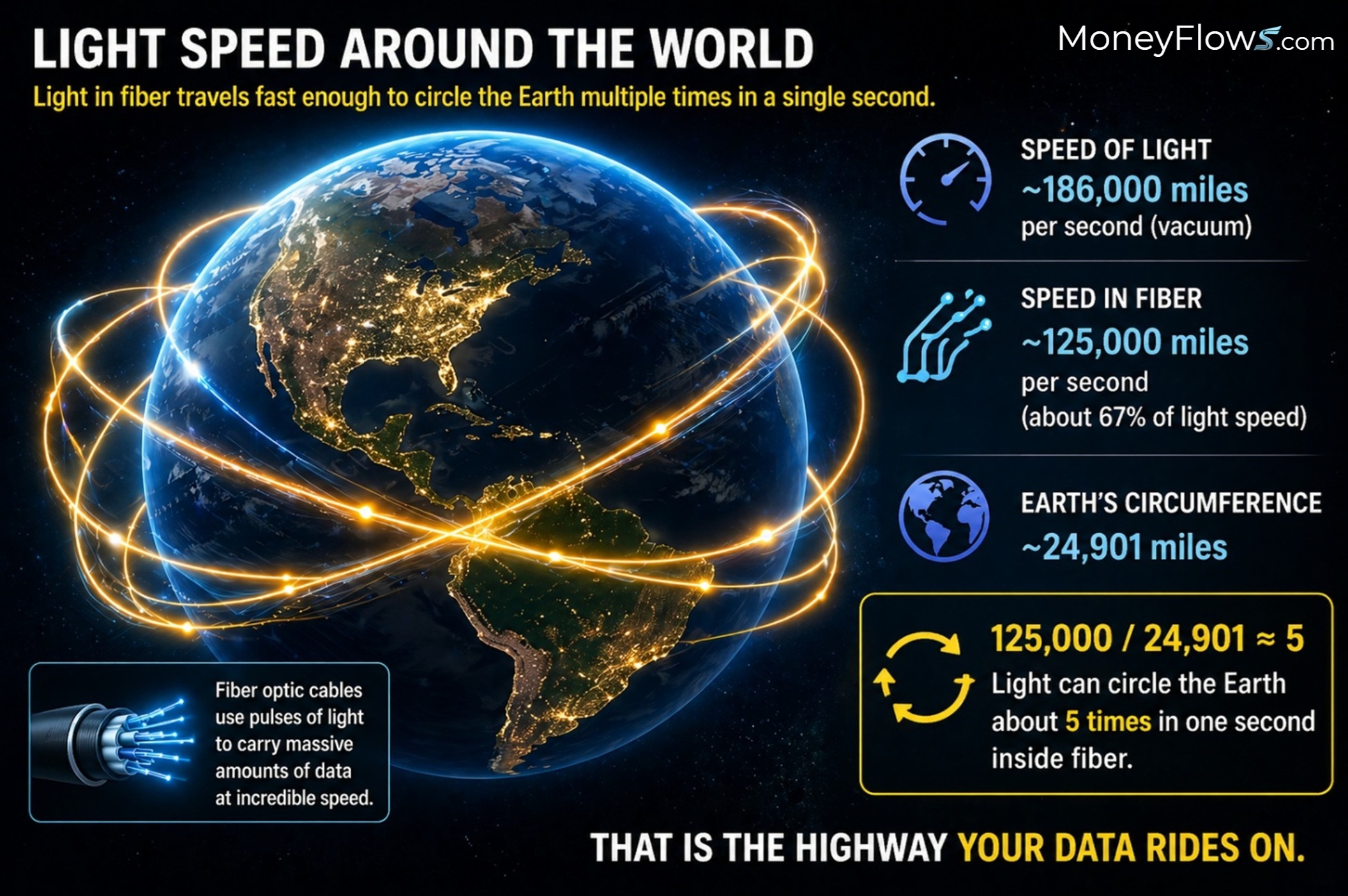
Even with all that speed, delays accumulate. Latency is the gap between when data is sent and when it arrives.
In everyday life, it’s barely noticeable, like a video that takes a moment to load. Inside AI systems, those delays compound. Thousands of chips must wait on each other. A single small delay ripples across the entire system. Milliseconds turn into microseconds, then nanoseconds.
Building the Optical Nervous System
At that scale, time becomes the choke point.
Now you can see that the solution isn’t just faster chips. It’s faster systems. Fiber optics and photonics have moved to the center of the AI story because they determine how efficiently data moves. The constraint has shifted from compute to communication.
A useful way to think about it is this: AI is no longer a single machine. It is a distributed system, closer to a living organism. Like any organism, it depends on its nervous system.
The faster signals move, the more capable the system becomes. AI’s nervous system is rapidly building on light.
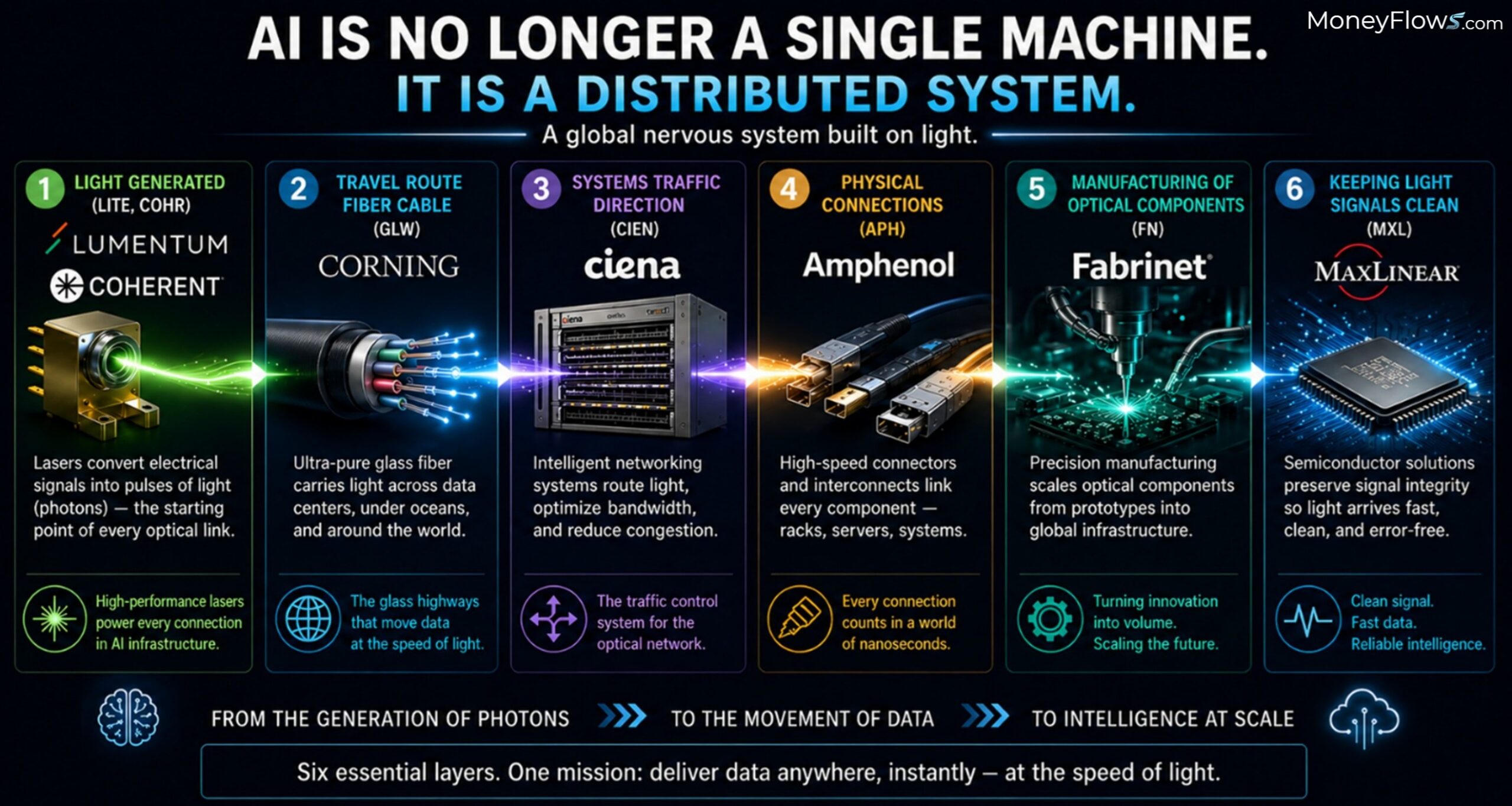
That system is constructed layer by layer by companies most people never hear about.
What’s fascinating is that at each layer, money has been flowing into the companies that make it possible.
The Key Players in the Infrastructure Chain
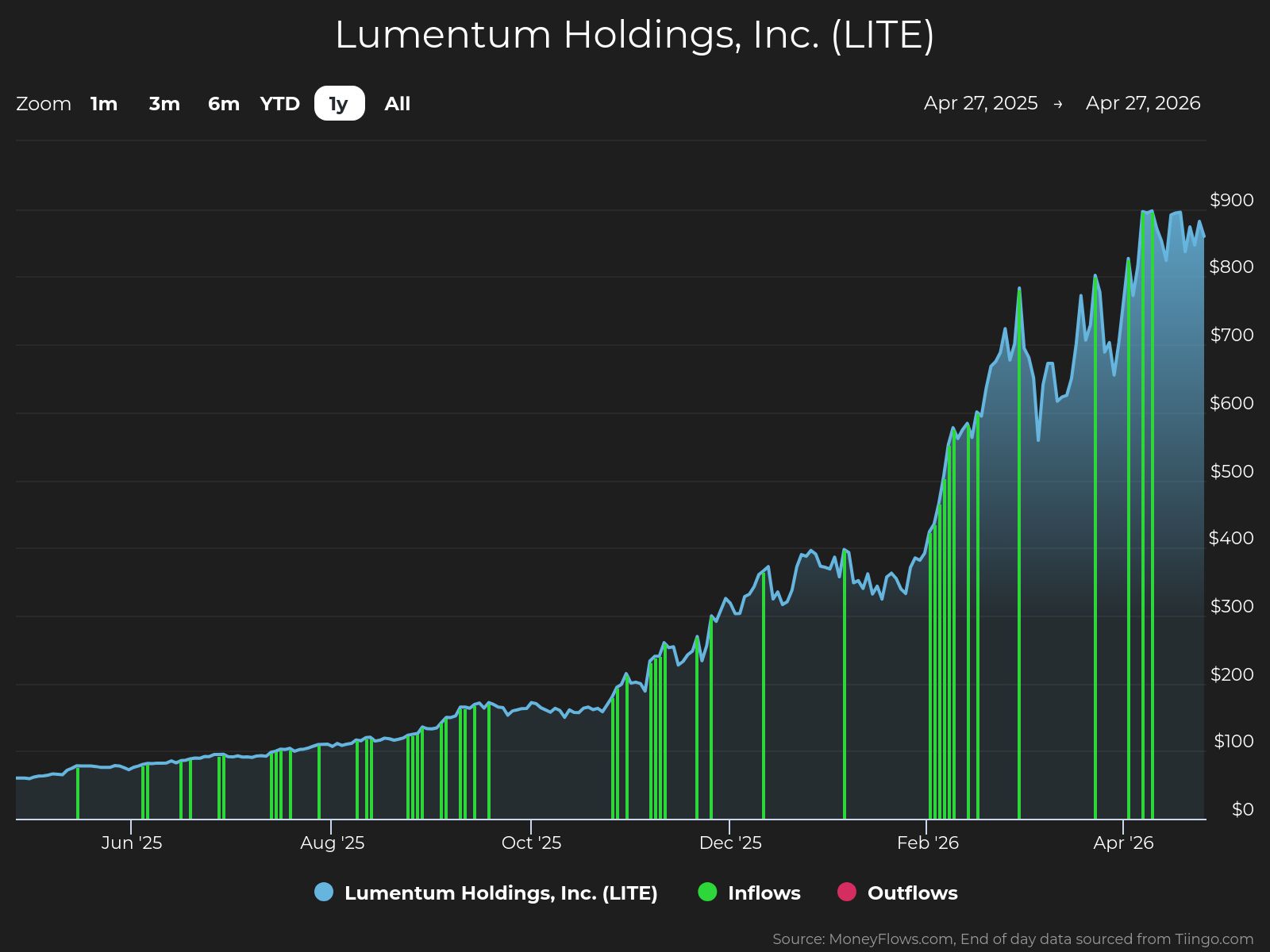
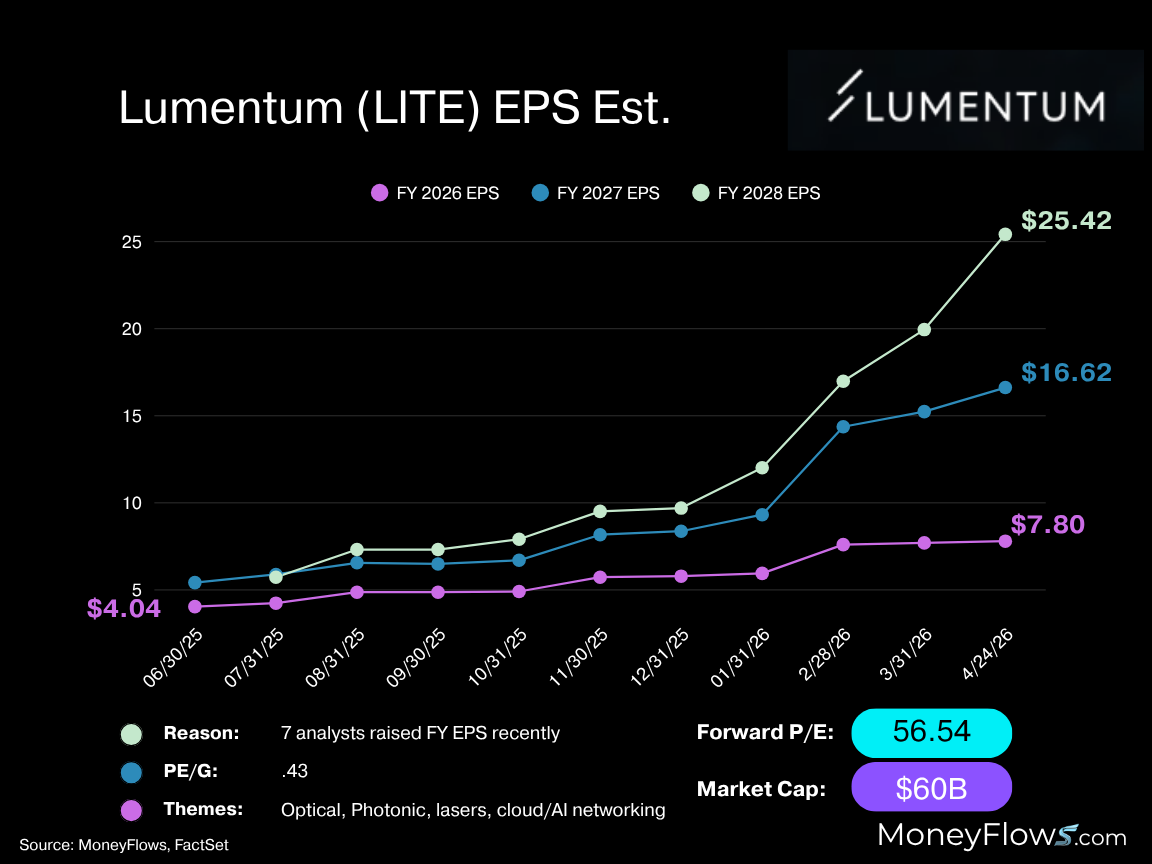
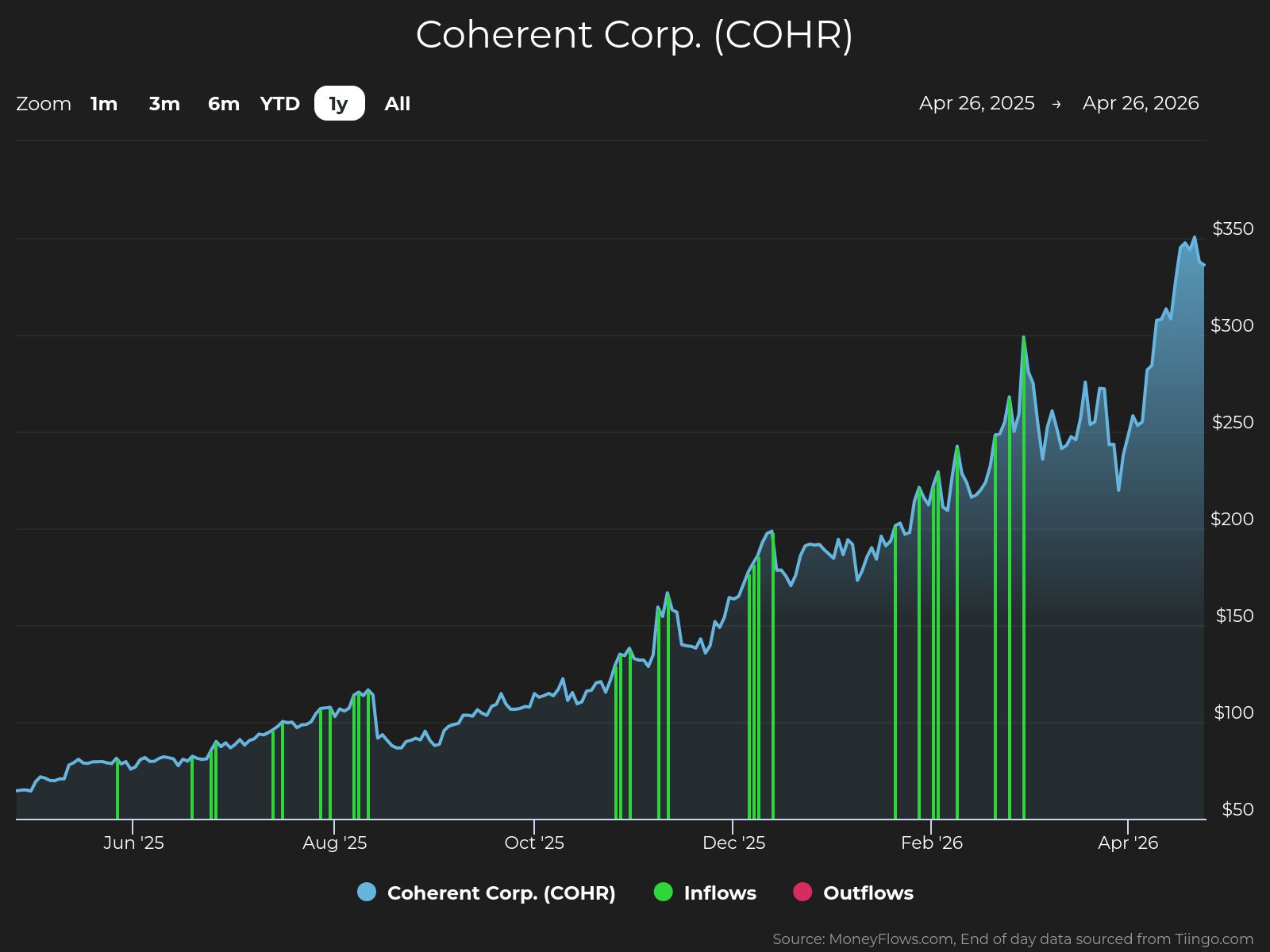
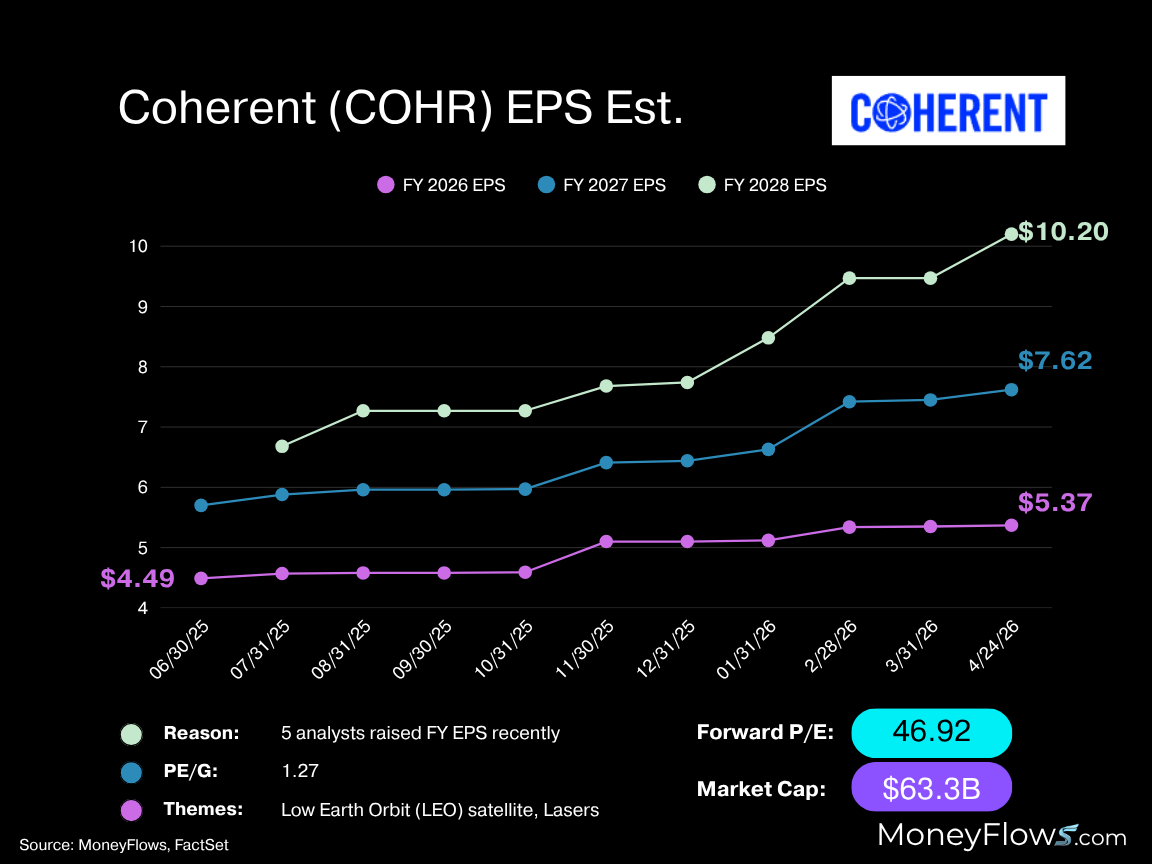
At the beginning of the chain, light must be generated. Lumentum Holdings (LITE) and Coherent Corp. (COHR) produce the lasers and photonic components that convert electrical signals into optical ones.
This is where data becomes light.
Lumentum is more tightly focused on data center and telecom optics, while Coherent brings a broader photonics platform that includes materials, components, and systems.
Together, they form the foundation of the optical layer, and as AI clusters scale, demand is rising for more powerful, efficient, and integrated light sources to keep data moving between chips.
Below highlights our flow signals on both LITE and COHR with forward EPS estimates on the right.
Institutions are piling in as these companies reach fundamental inflection points:
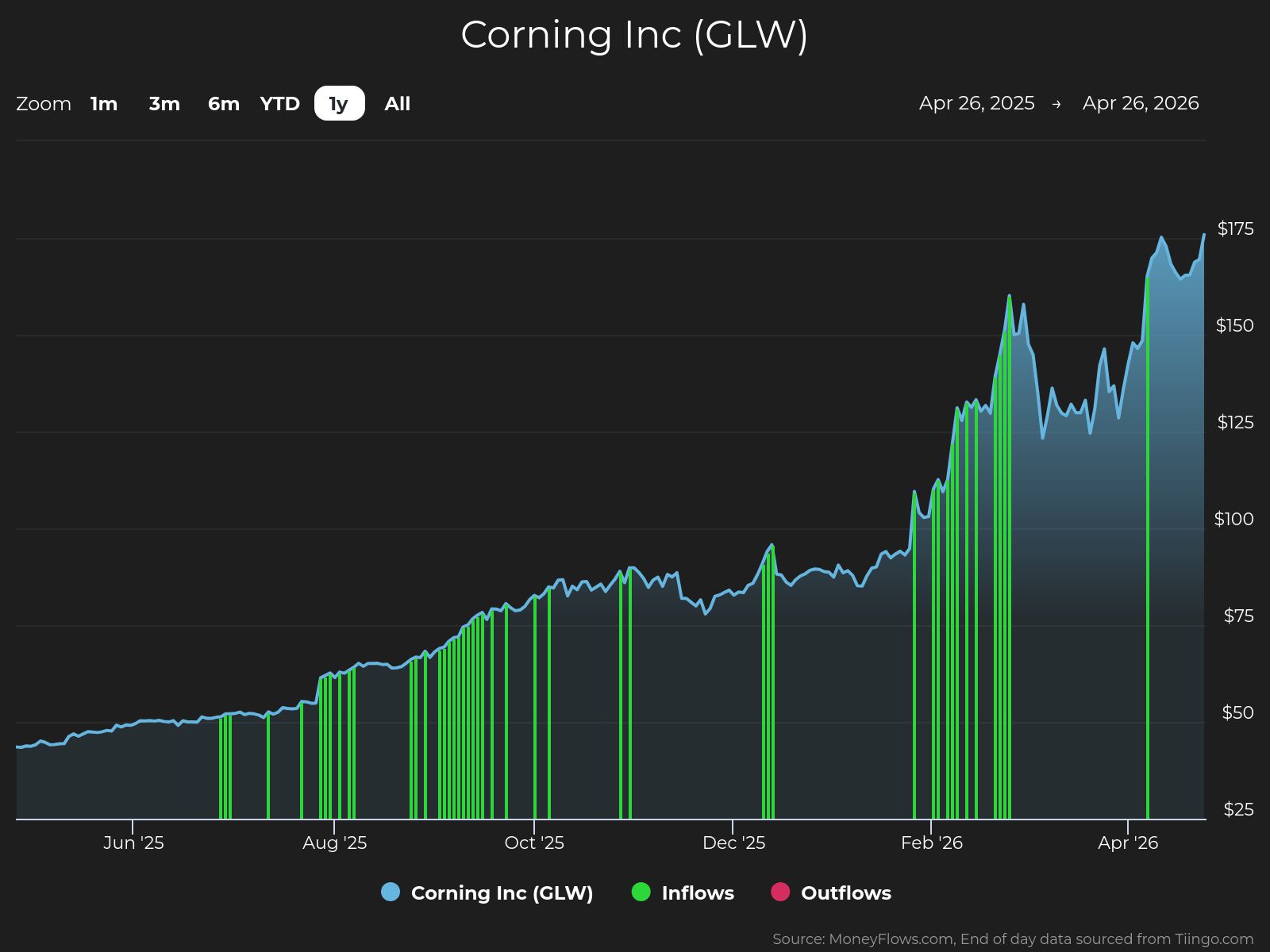
Once generated, light needs a path. Corning Inc. (GLW) manufactures the fiber optic cables that carry data across servers, data centers, and continents.
Modern fiber increases capacity by transmitting multiple wavelengths at once, expanding throughput without laying new cables.
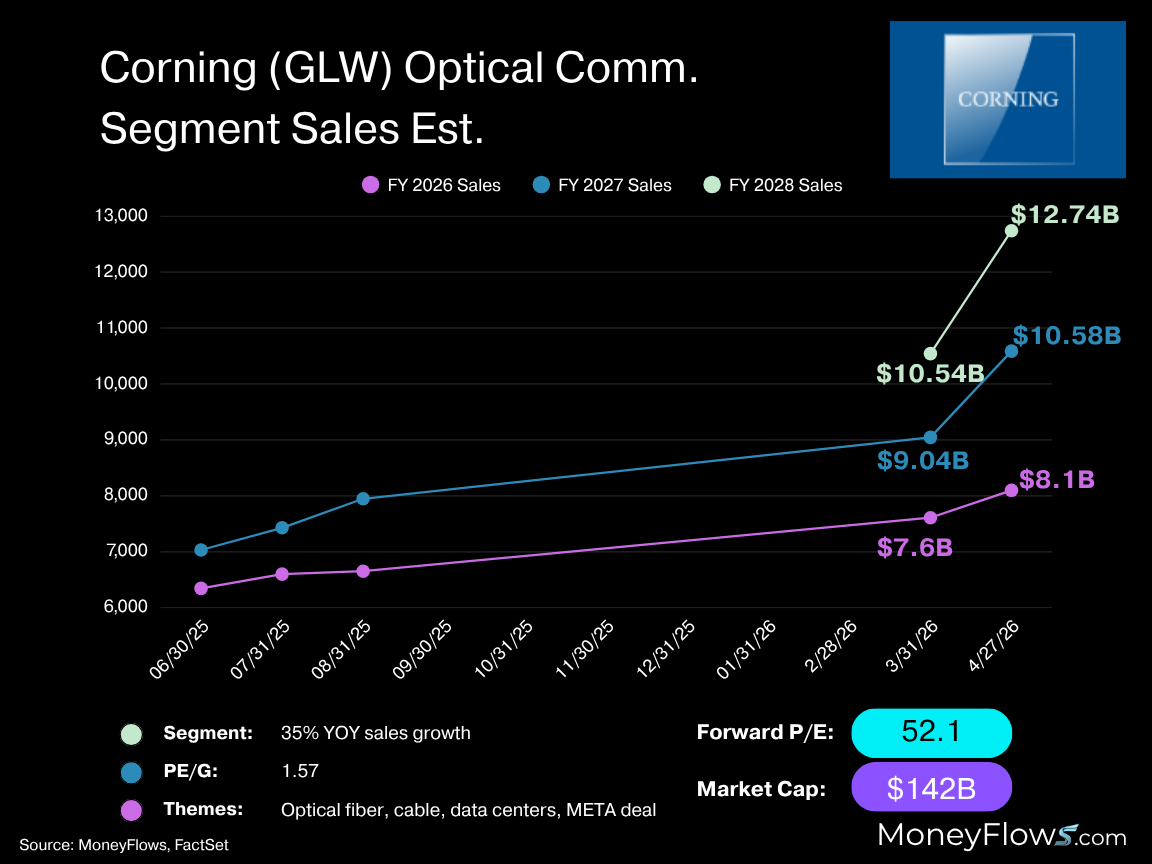
GLW has attracted a lot of attention lately. Their Optical Communications segment continues to drive the growth narrative with recent hikes to revenue estimates:
Traffic must still be directed. Ciena Corporation (CIEN) builds the systems that route light through complex AI environments.
As clusters scale to thousands of GPUs, moving data between them becomes exponentially more complex.
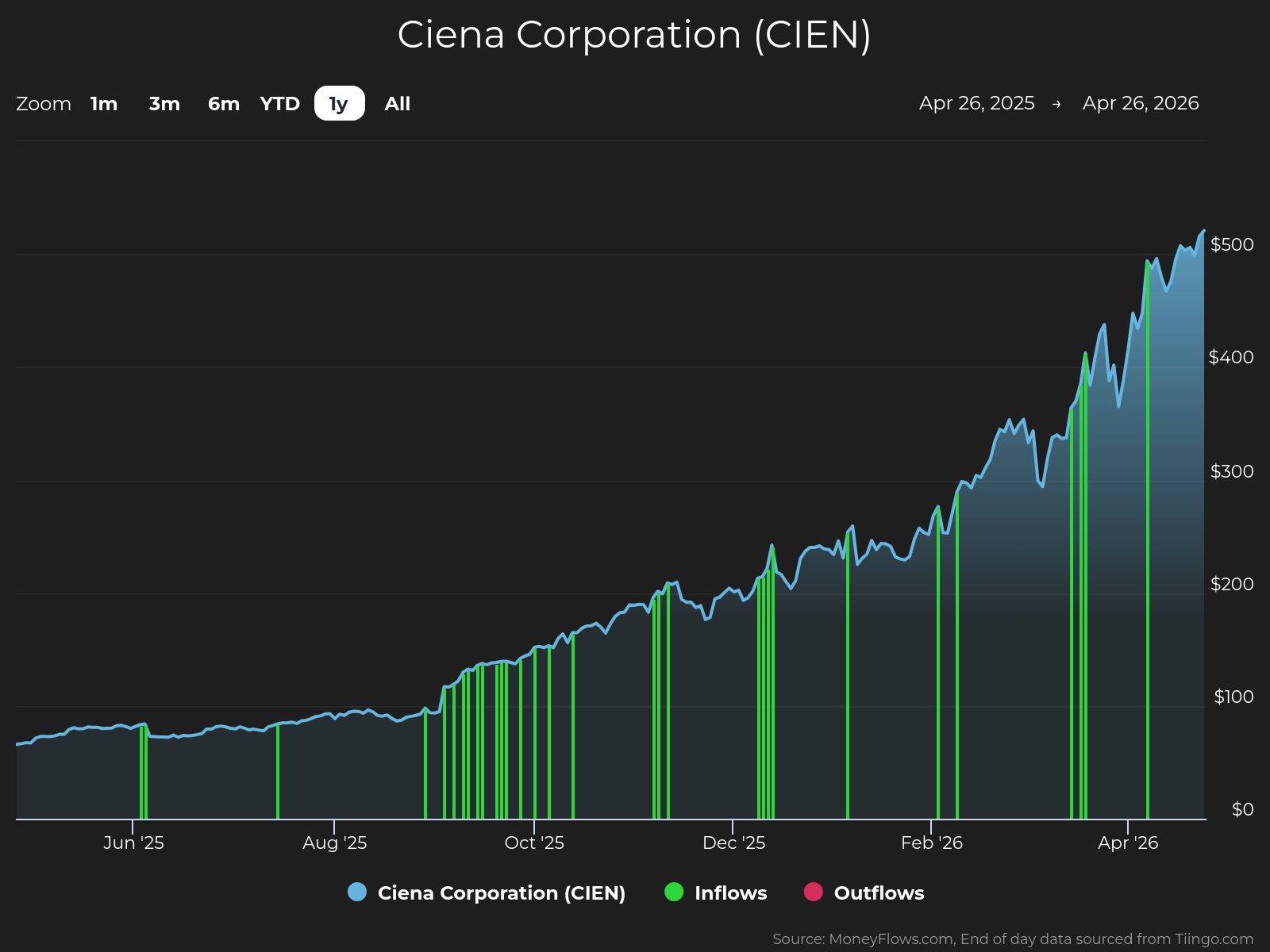
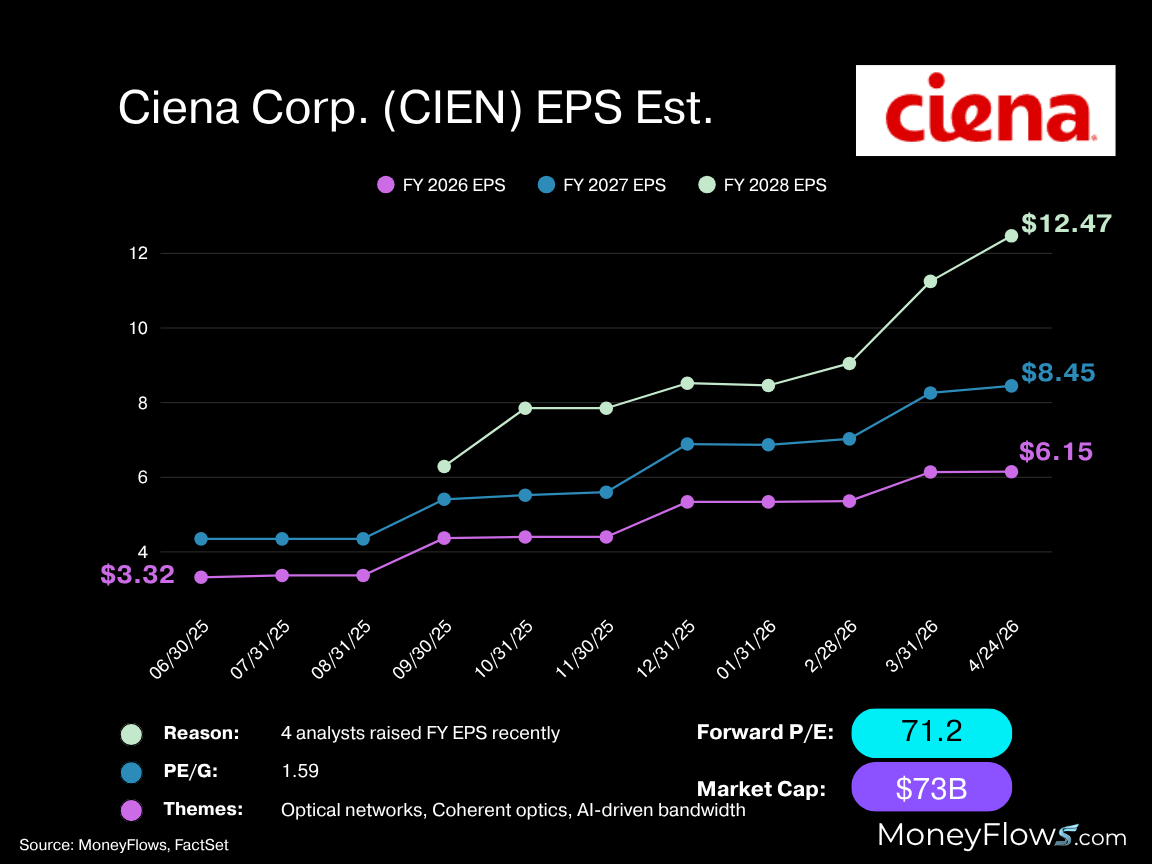
CIEN shares have been under immense inflow pressure. When you review the EPS trajectory, this makes sense.
We’ve learned that stocks follow earnings.
When it comes to big themes, however: Earnings follow stocks.
Everything must also connect physically.
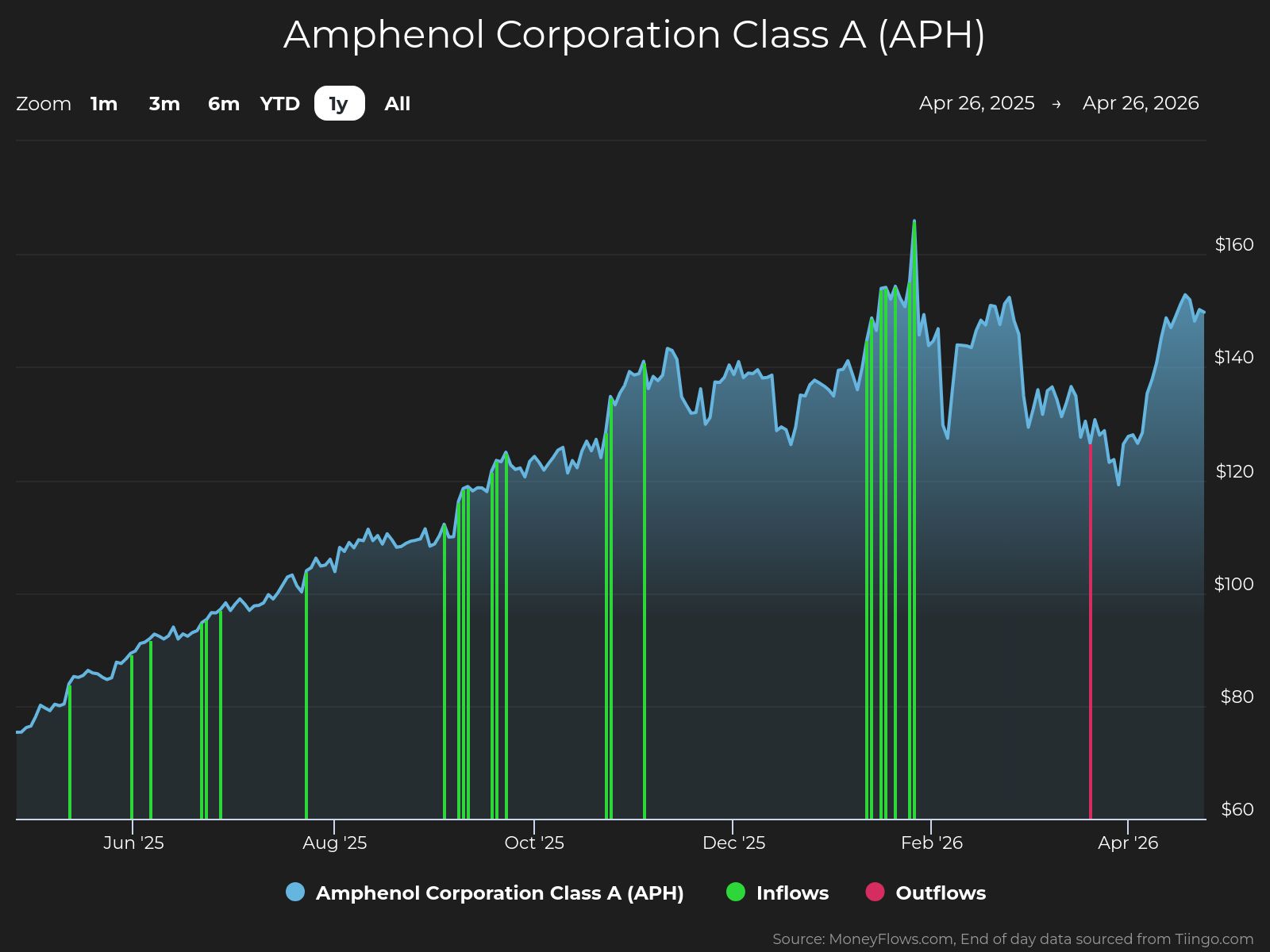
Amphenol Corp. (APH) produces the high-speed connectors that link servers and systems. In hyperscale environments, even small improvements at these connection points can have meaningful effects on speed and power efficiency.
APH shares have been in demand.
Scaling the system requires manufacturing.
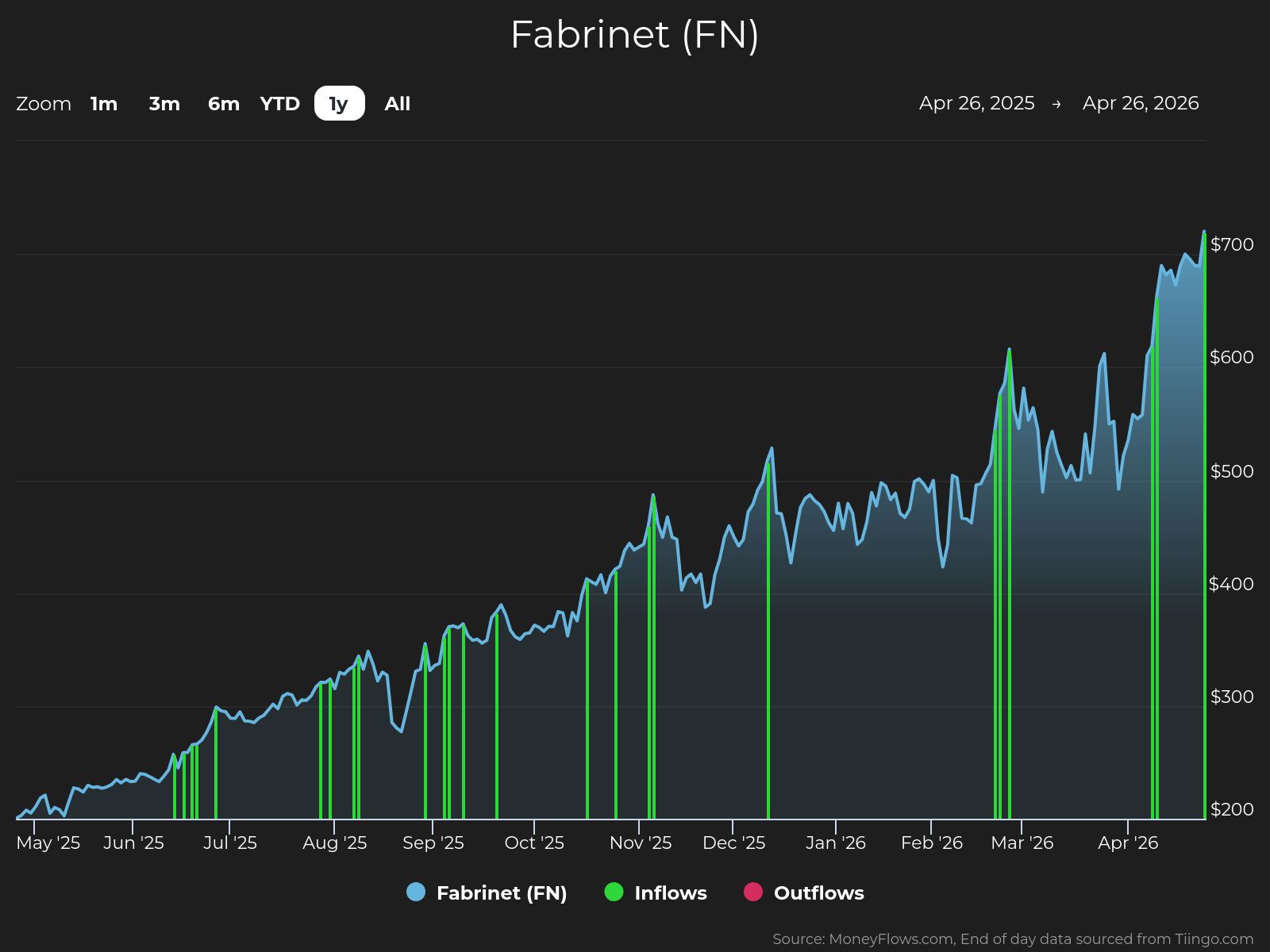
Fabrinet (FN) builds the optical components that allow this infrastructure to expand. As demand increases, production capacity becomes a constraint.
Again, flows tell the story. Money is chasing fiber stocks:
Signals must also remain clean as they move.
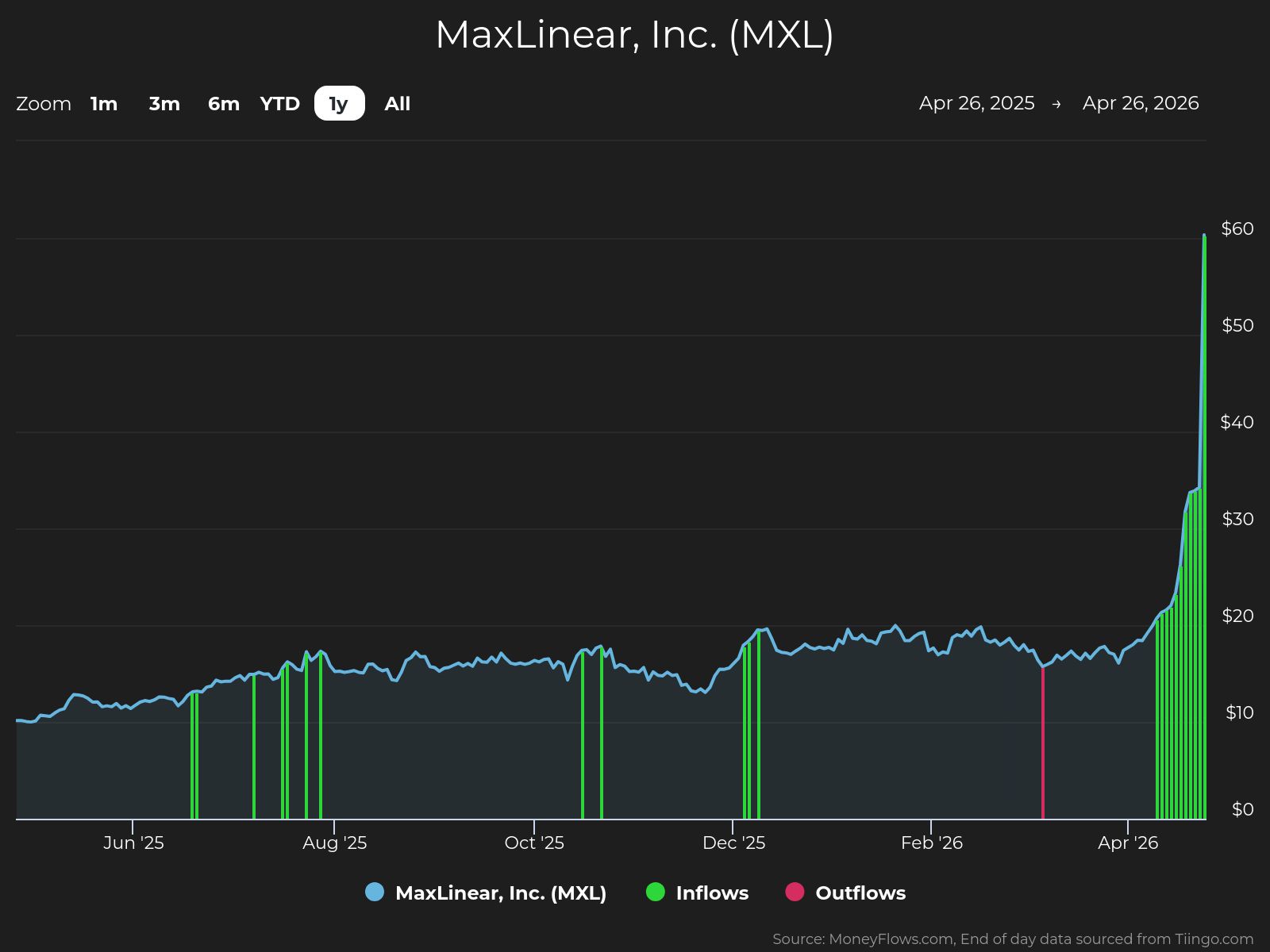
MaxLinear (MXL) develops chips that manage and optimize signal integrity. As data rates push toward 800Gb/s and beyond, maintaining signal quality becomes more challenging.
At 800G, you’re moving about 100 gigabytes of data every second, roughly the equivalent of transferring a full HD movie in a fraction of a second.
MXL had one of the largest beat and raise earnings reports in April:
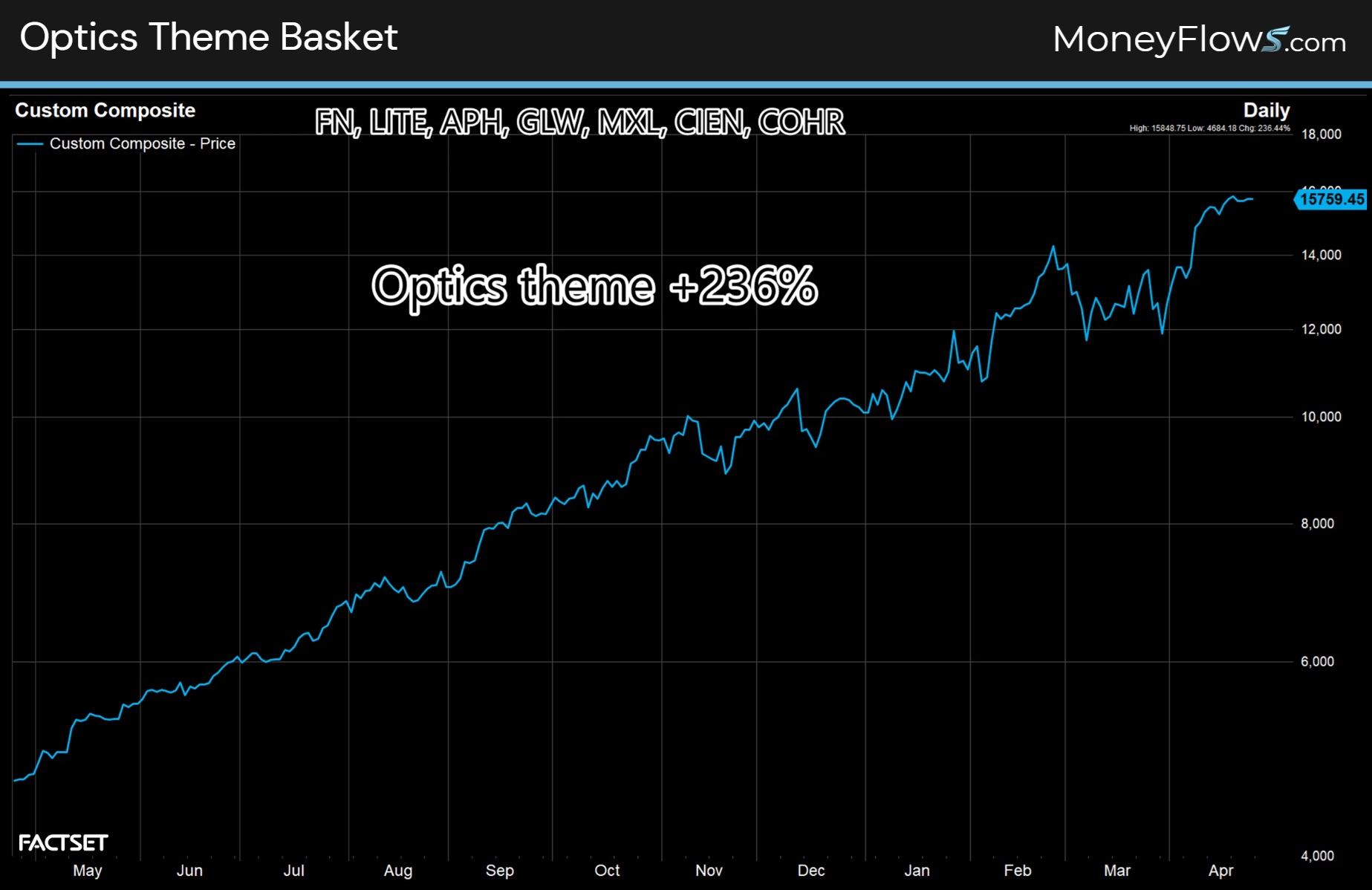
Looking at this through a different lens, we can see the massive growth is happening right under our noses.
Here are the stocks assembled in a basket – kind of like its own Optic ETF. The chart speaks for itself:
Each company represents a layer, and each layer matters. The system is only as strong as its weakest link… slow one down and the entire system feels it.
The shift underway is straightforward but seismic. Compute power drove the last phase of AI.
Communication is shaping the next.
The system connecting chips now determines how far and how fast AI can scale.
AI runs on more than chips… it runs on the system connecting them.
That system is built on light.
Once you see it this way, the opportunity expands beyond a single breakthrough or company.
It spans an entire ecosystem, from generating photons to moving data across the globe.
This is the buildout of a new kind of infrastructure, a global nervous system operating at the speed of light.
And it is still early innings…
To get access and make even more from this call to action, sign up for a PRO membership.
Good things happen when you follow the data instead of the crowd!
You’ll get access to our proprietary indicators and learn how our unique money flow approach finds outlier stocks early.
Professional money managers and RIAs looking for additional portfolio solutions including ETF flows & ranks and your own Portfolio Tracking tools, please reach out about our Advisor Solution and Emerging Advisor Program.
This time, be early.
Our process helps investors “be early” to trends.
Go with the Flows!