
High Oil and Surging Volatility Will Not Derail the Stock Market
Our 2026 Outlook warned to brace for an uptick in volatility.
It’s here.
We’ve also seen a massive spike in energy prices.
Taken together, equities are struggling.
But it’s not all bad news.
High oil and surging volatility will not derail the stock market.
Let’s unpack the environment. Macro uncertainty is sky high.
Iran is the biggest problem but it’s only part of the story. There’s also AI disruption worries, growing private-credit jitters, a softening job market, and stubborn inflation that’s jeopardizing future Fed rate cuts.
These macro risks are tightening financial conditions as rising oil prices push up interest rates and the dollar.
All this is driving the first market correction since last spring’s tariff tantrum.
Below we’ll prove how, the vast majority of the time, corrections are juicy buying opportunities rather than the start of durable bear markets.
The reality is no one knows how long it will take to end the Iranian conflict. Over the short-term expect volatility to continue.
Today’s piece is meant to give intermediate to long-term investors the conviction to step in and buy quality companies on sale.
We’re zeroing in on a pair of contrarian signal studies to help you find opportunity amid the turmoil.
There are sectors and stocks to overweight until the coast clears.
High Oil and Surging Volatility Will Not Derail the Stock Market
The primary transmission mechanism by which the war in Iran impacts markets is through oil prices.
Since it’s impossible to predict precisely how, and when, the conflict will end, energy uncertainty has quickly become a major equity overhang.
WTI crude is up to $99/bbl. from $67 when the Iranian conflict began on February 28. Similarly, the average price of a gallon of unleaded gasoline in the US has risen to $3.90 from $2.92.
But it’s important to realize that gasoline consumption represents just 2.5% US consumer spending. Shelter is 35% of consumer spending - a huge spike there would big a much bigger economic deal.
Here’s what matters.
On March 5th and 6th, WTI futures logged daily gains of 8.51% and 12.21% respectively.
Since 1990, the average S&P 500 advance 3-months and 6-months after two consecutive days of 5% spikes in WTI crude oil is a healthy 4% and 8%, respectively (chart).
Better yet, the S&P’s average 12-month gain is 22% with 83% positivity.
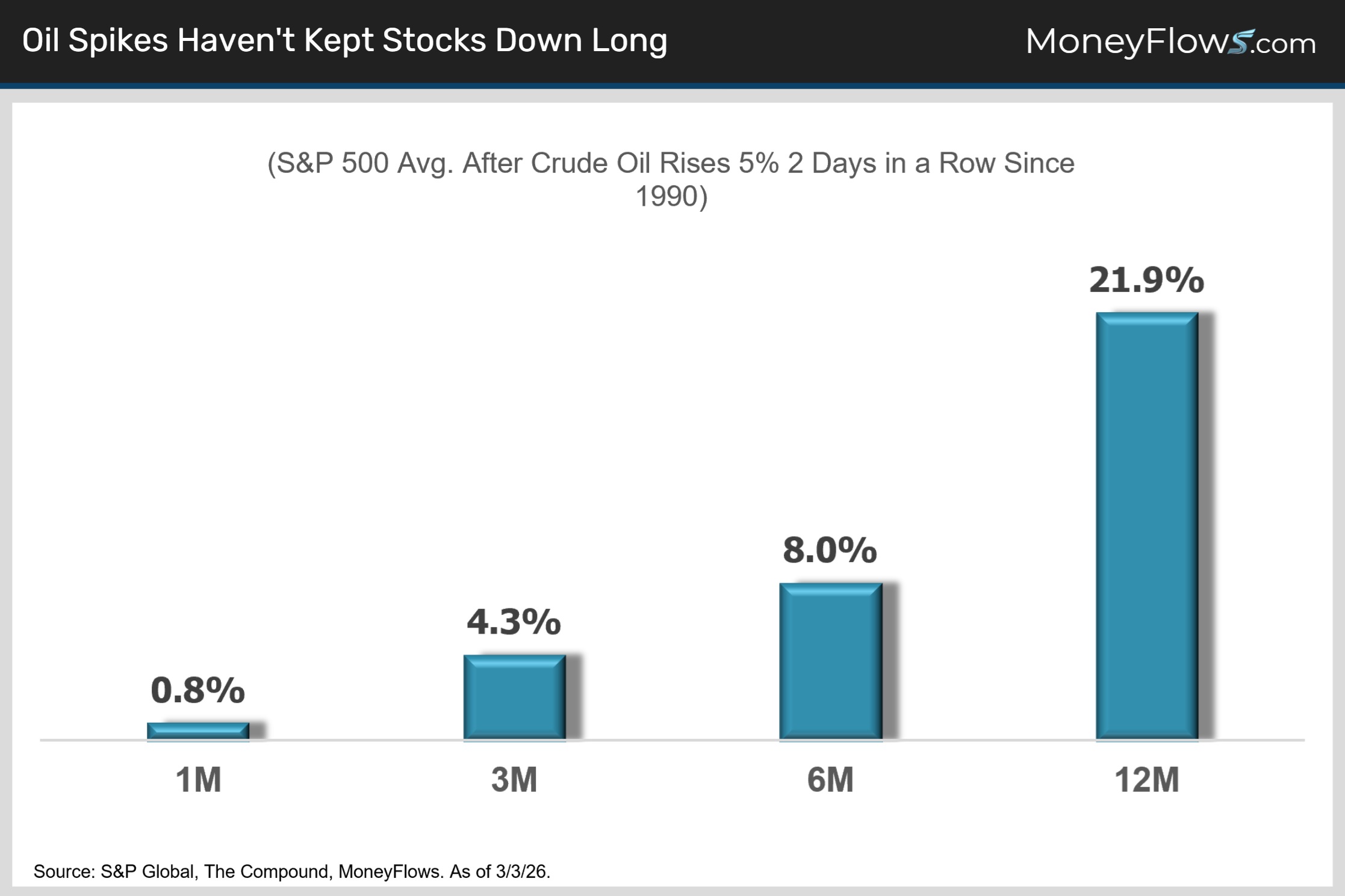
Surging oil prices will not derail the stock market.
VIX Surges Far More than Credit Spreads
The relationship between equity stress (VIX) and credit stress (high yield spreads) holds valuable clues about what’s ahead for stocks.
During the current bout of risk aversion, the VIX’s rise is far outpacing credit spread widening (chart).
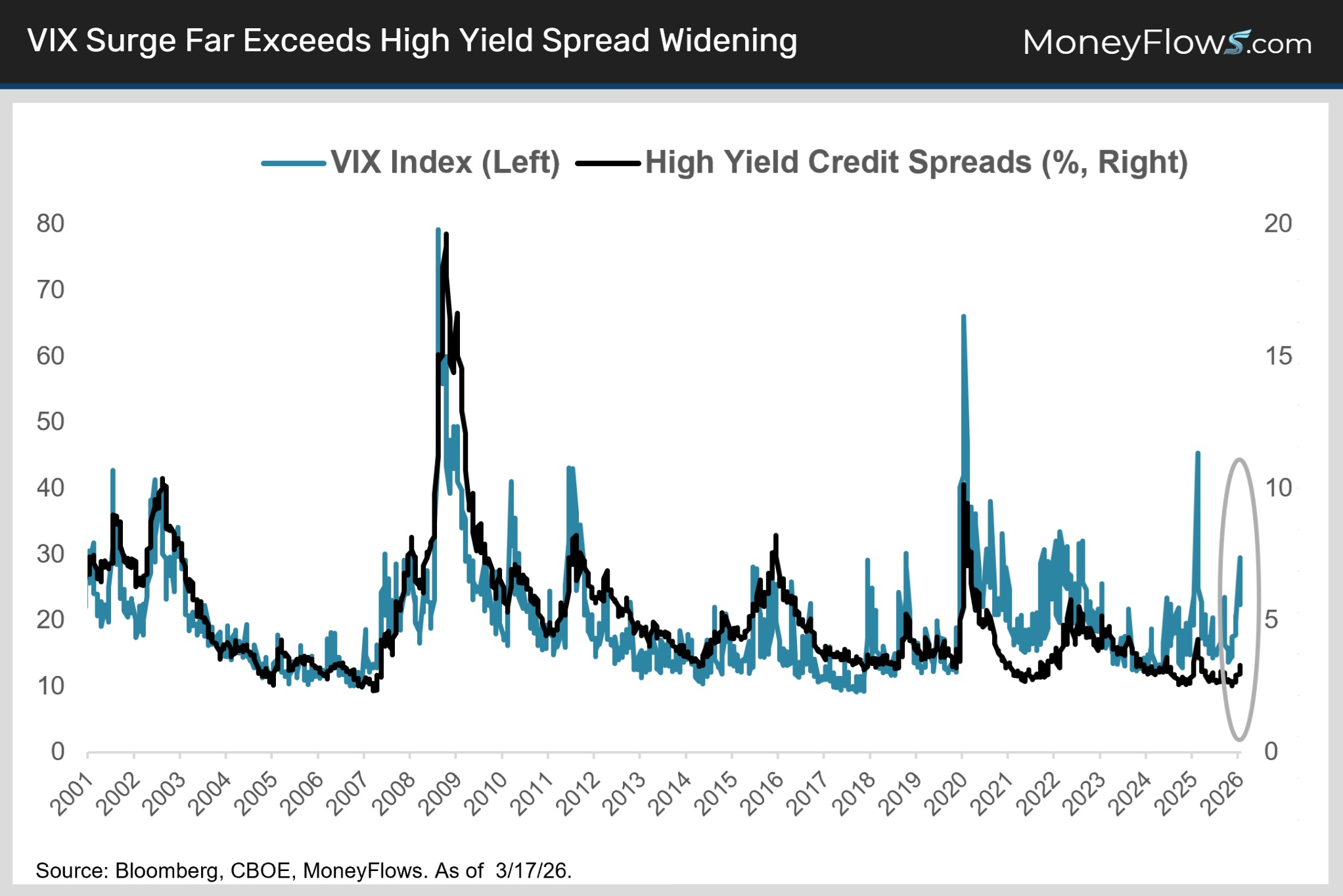
The bond market is often considered the "smarter" market, and when it fails to panic alongside a surging VIX, it often signals that the equity panic is overdone, creating a, buying opportunity.
For example, we saw the same equity/credit dynamic last April, which turned out to be an epic time to buy.
Since 1990, the S&P 500 has averaged 15% to 20% gains a year after relative equity panics like we’re seeing now:
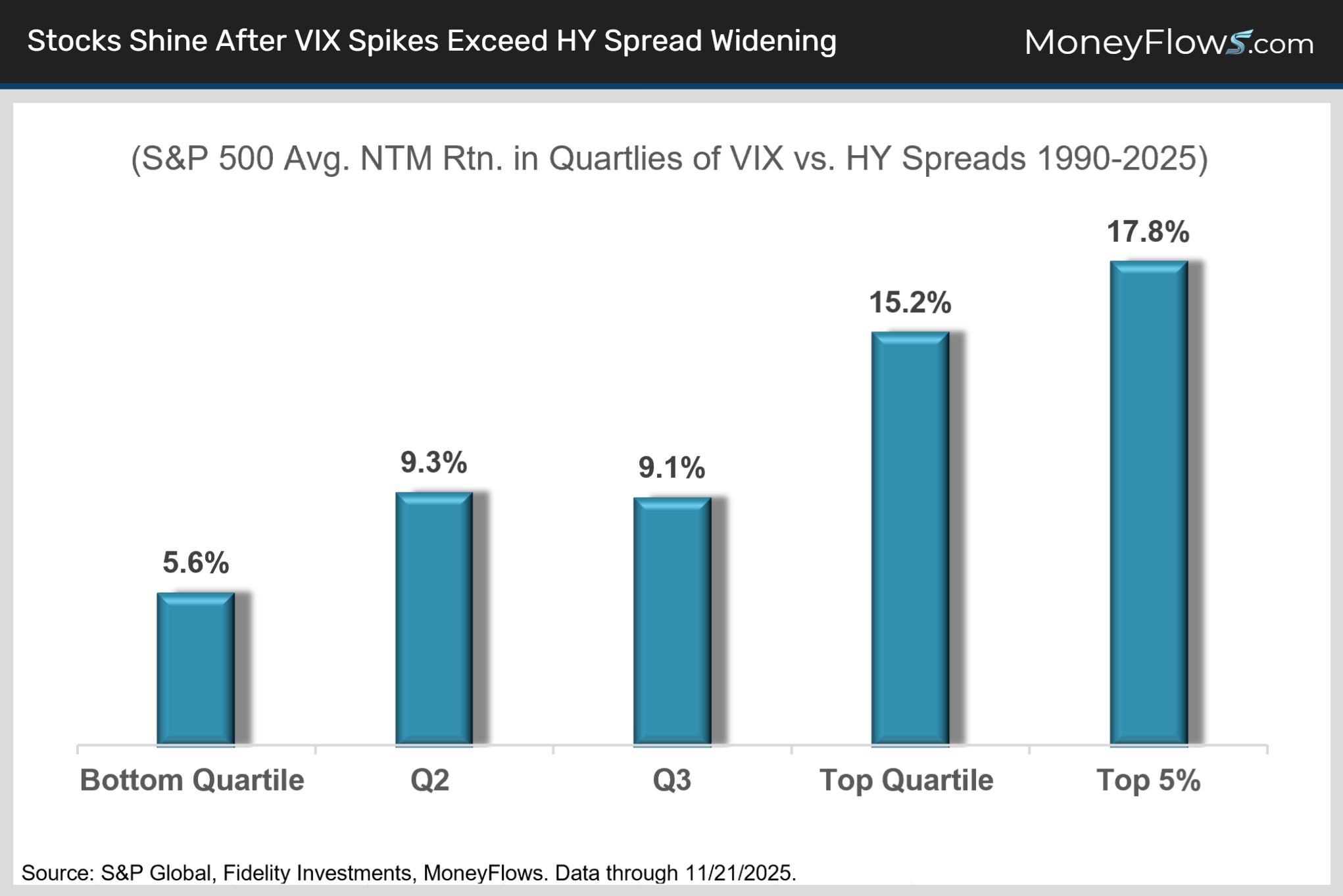
Surging volatility will not derail the stock market.
What This Means for Your Portfolio
HALO (heavy asset, low obsolescence) stocks in energy, materials, industrials, semis, and higher yielding utilities still remain leadership.
These 2025 laggards are all up YTD even as the S&P chops lower (chart):
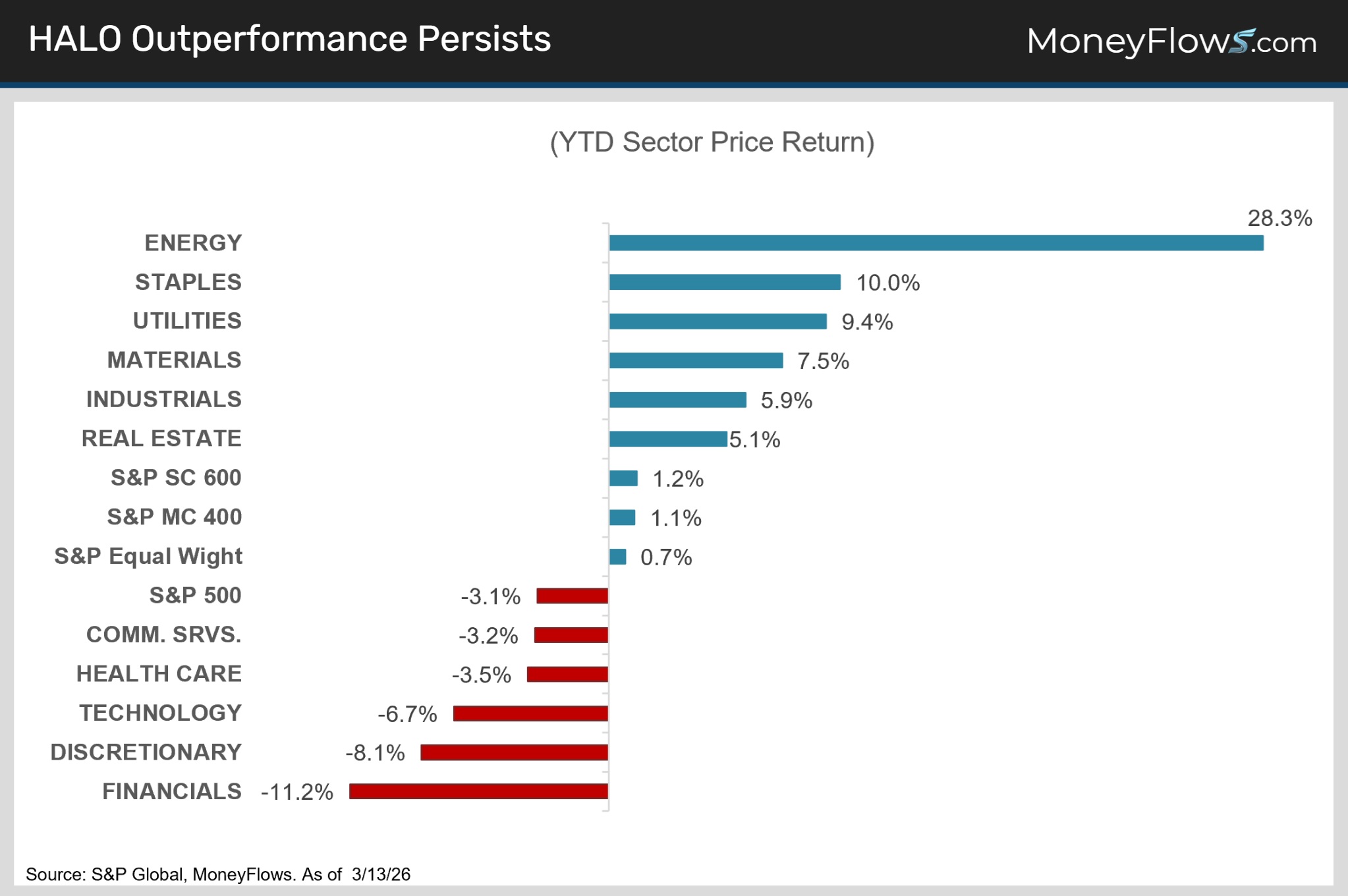
Here’s what explains 2026’s massive rotation:
HALO – heavy asset, low obsolescence is the new equity leadership theme, while service oriented, software businesses are seeing their multiples re-rated sharply lower.
Markets are rewarding real world physical capacity, networks, infrastructure and engineering complexity - assets that are hard to replicate and less exposed to potential technological obsolescence from AI.
What’s In: Think semis, energy, mining, defense, aerospace, power generation, utilities, transport infrastructure and critical machinery.
What’s Out: asset light, software heavy, service business models found primarily in the tech, communications, financials and discretionary sectors that may either see slower growth or be completely disrupted as AI adoption spreads.
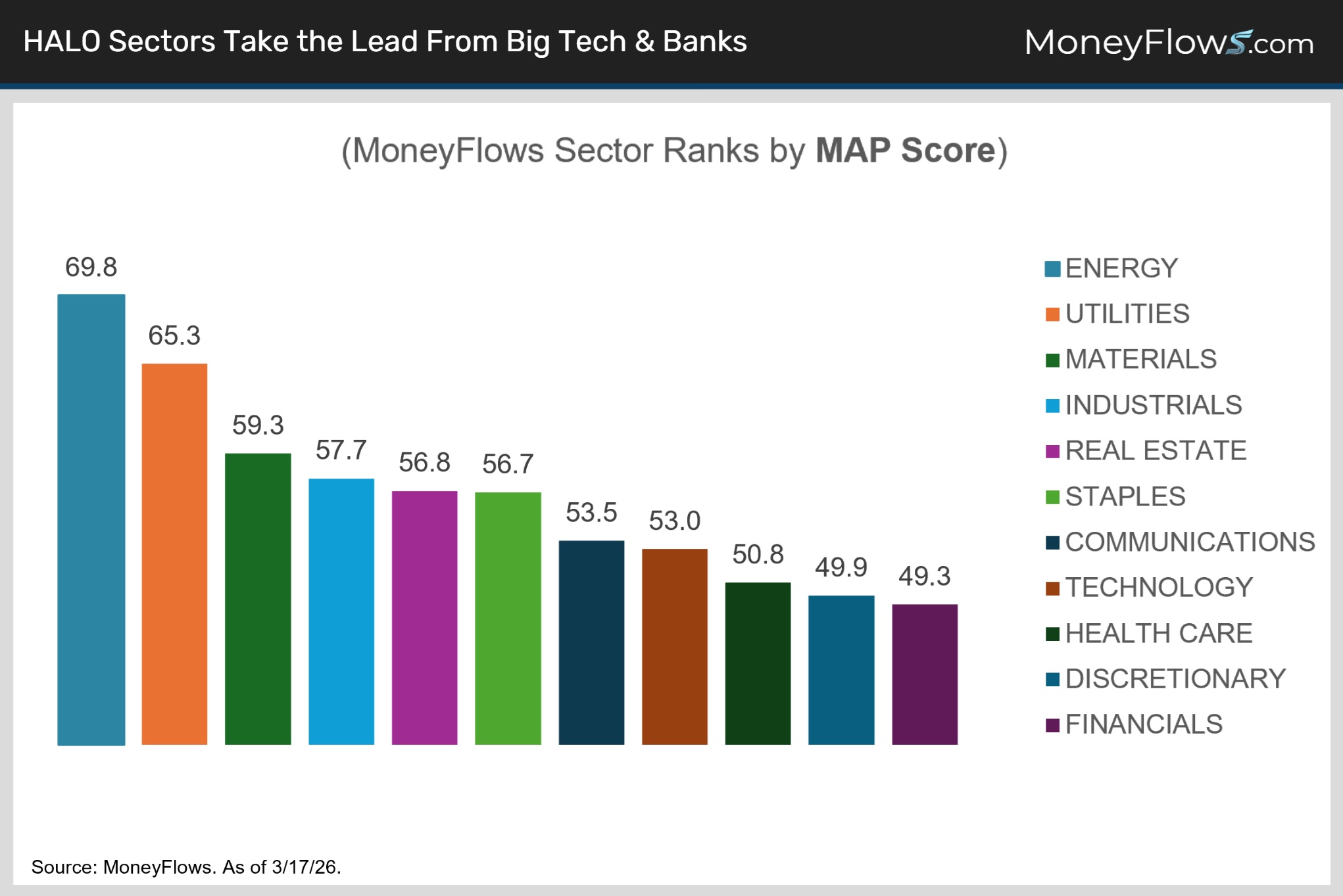
MoneyFlows sector rankings favor winning HALO-heavy sectors at the expense of asset light service businesses in the financials, discretionary and technology sectors:
When volatility rises it’s important to up the quality when you buy on dips to account for heightened macro risk. This isn’t a time to buy highly speculative stocks.
Today’s equity list focuses on wide-moat, HALO names in the energy, utilities, materials, semi and industrials sectors seeing the biggest institutional inflows.
Our data is built to find the outlier stocks ahead of the crowd.
To get access and make even more from this call to action, sign up for a PRO membership.
You’ll get our proprietary indicators and learn how our unique money flow approach finds outlier stocks early. Give it a shot!
If you’re a money manager or RIA and want portfolio solutions and deep ETF insights, reach out about our Advisor solution here.
Be early next time.
Go with the flows!
HALO is the play for 2026.
Each of the 25 stocks below, for PRO members, exhibits market leading qualities.
They’re all under healthy accumulation with strong fundamental grades: